 By Lucy Vale
Cover letter examples by role - what changes across 11 jobs, and when they get read
Cover letter examples for 11 roles - management, government, sales, admin, healthcare and more - grounded in what real hiring managers say: what changes by job, and the honest truth about when a cover letter even gets read.
Search "cover letter examples" and you get a thousand templates. They all assume the same thing: that someone will read your letter closely and be moved by it. But the people who actually do the hiring tell a different story. Many cover letters are never read. A hiring manager on a tech forum put it plainly: "I've looked at 1,000+ profiles and have never read a cover letter." One applicant even got hired with the wrong company name in their letter — a sign no one opened it. And the cheerful stats that say 80%-plus of employers read and weigh every letter? Those usually come from companies that sell resume tools, so take them with a grain of salt.
So why write one at all — and why by role? Because "often unread" is not "never read." The moments a letter does get read are specific and easy to predict. It gets read when a human already likes your resume and is choosing between you and someone just as good. When your resume has something to explain — a gap, a career switch, being over- or under-qualified. When a small or mission-driven employer reads everything. And when the posting requires one, where a missing or sloppy letter quietly knocks you out. In those moments the letter earns its place. And what a good one says changes a lot from job to job. A government cover letter and a sales cover letter are barely the same document.
This is a tour of what actually changes across eleven common roles, grounded in what real hiring people and applicants say — not what the templates pretend.
What's true for every role first
A few rules hold true everywhere. Break them and your letter fails faster than any role-specific mistake:
- Don't restate your resume. The most common complaint from people who read letters: it just repeats the resume in paragraph form. The letter's job is to add what the resume can't — a story, a connection, a reason.
- Put your best line first. Assume five to ten seconds of attention, and only after your resume already caught their interest. The opening sentence has to earn the rest.
- Sound like a human. This is the whole game now. Recruiters say AI-written letters all arrive "eerily alike," and they skim right past them — so if yours reads like ChatGPT wrote it, it's working against you.
- Never send a visibly generic one. "To Whom It May Concern" and a company name you clearly swapped in are instant tells, and worse than sending nothing. If you can't tailor at least the opening, skip the letter where it's optional.
- Match effort to the reader. Put real work into jobs where a human reads everything — small companies, senior roles, career changes. Don't burn hours on high-volume pipelines where the letter is probably never opened; tailor your resume for those instead.
Now, by role.
Management cover letter
For management roles the letter is more likely to reach a real decision-maker — often your future boss, or their boss. So your judgment and polish get checked harder, and sloppiness reads as "entry-level." Lead with the size of what you've led, in numbers, not adjectives: team size, budget or P&L (profit-and-loss responsibility), span of control, and a result you drove through other people (cut resolution time 40%, promoted four reps, lowered attrition). "Proven leader" with no proof is exactly what every other applicant wrote too. After that, the rules split by sector: corporate wants one page and hard numbers; federal supervisory roles echo the announcement's KSA language (the "knowledge, skills and abilities" it lists) and can run long; nonprofits want genuine mission fit; and an internal promotion skips the "I'm writing to apply" intro completely — that case has its own internal-vacancy playbook.
Opening that works: "Over three years leading a 12-person support team, I cut average resolution time 40% and promoted four reps into senior roles — the team-building I'd bring to your Customer Success Manager role." Not: "I am writing to express my interest in the Manager position."
Government job cover letter
Federal hiring runs in three gates, and the letter barely touches the first two. On USAJOBS, a computer scores your occupational questionnaire (the self-rating survey) and rates your resume against the OPM standard for the job. It stores your cover letter but does not score it. Next, an HR specialist spends a few minutes confirming your top-rated resume really backs up your self-ratings, then builds the "certificate of eligibles" — the shortlist. Only if you make that list does the hiring manager — your future supervisor — read the full package, letter included. So write the letter to that person, and put most of your energy into the questionnaire and resume. When you do write it: put the announcement number, title, grade and series in the first sentence; mirror the announcement's specialized-experience wording word for word — not for a bot, but for the human who can't guess what you mean; and back each requirement with a number. Then check the Required Documents section: some postings (for example many SES, Direct-Hire and Pathways roles) list the cover letter as required, and leaving it off marks your whole application incomplete.
Opening that works: "I am applying for the GS-13 Program Analyst position (0343 series), Announcement #HHS-26-CMS-12203987. My eight years managing CMS program budgets meet the specialized-experience requirement to [paste the exact KSA wording]: in FY24 I reallocated a $14M appropriation across five offices with zero anti-deficiency findings."
Sales cover letter
Sales is the one role where the letter is judged as a work sample of your selling — so a short, numbers-first, persuasive one can genuinely help, while a metric-free one is worse than none. Recruiters and sales managers (who carry a quota themselves) say they skim these fast and read only the tight ones. Lead with hard, comparable numbers in the first two lines: quota attainment; dollars closed shown next to your quota, so over-performance is obvious at a glance; and a rank ("#3 of 18 reps") or President's Club. Keep it to about five sentences or a few bullets, and consider bolding the numbers so a quick scan lands on them. Match the posting's CRM (the sales software, like Salesforce), market segment and sales motion. For an SDR or BDR (entry-level sales reps) with no quota yet, lead with activity proof instead — dials per week, meetings booked, cold-to-meeting conversion.
Opening that works: "Last year I closed $1.2M against a $900K quota — 133% of target, #2 of 14 reps — and I'd like to point that same motion at [Company]'s mid-market book."
Administrative assistant cover letter
For admin roles the letter is a literal work sample: it shows your organization, your ability to follow instructions, and your error-free writing — the actual skills of the job — so a typo or the wrong company name sinks you here in a way it wouldn't elsewhere. It's also read more often than average; some admin hirers won't even look at an application without one, and use its presence and polish as the first filter. So prove you're organized instead of claiming it: give a concrete example — ran calendars for three directors, handled 80+ emails a day, rebuilt a filing system so it took seconds instead of minutes to find a document — ideally with a number. Mirror the posting's top required skills in its own words and order. And for detailed government or university postings, answer each stated requirement point by point (a two-column "your requirement / how I meet it" table is a proven format).
Opening that works: "I'm applying for the Administrative Assistant role at [Company]. Organizing is the thing I do compulsively — I keep calendars for three directors, field 80+ emails and 30-plus calls a day, and last quarter I rebuilt our filing system so document retrieval dropped from minutes to seconds."
Secretary cover letter
A secretary's letter is also the test — it is a writing sample and an attention-to-detail check, which is literally the job. One hiring manager said he reads them mainly "to look for grammar and phrasing." And because secretary jobs are often in small offices, schools and law firms with a single person screening, the letter gets read more than average. Lead with proven reliability and discretion — you hold the calendar, the petty cash, the confidential records — tied to a real accuracy number, not the "detail-oriented" everyone claims. Then match the setting: legal wants flawless copy and perfect deadline and filing accuracy, with zero tolerance for typos; medical wants comfort with terminology and named systems (MEDITECH, or an EHR — electronic health record system) plus a calm, patient-facing manner; school wants warmth as the front-of-house voice plus discretion; government wants the announcement number on line one and the KSA wording mirrored word for word.
Opening that works (legal): "In three years as a legal secretary I never had a filing rejected for a formatting or deadline error — the reliability I understand [Firm] needs at its front desk."
Clerical cover letter
"Clerk" covers two very different employers. Government and civil-service clerical postings often replace the free-form letter with a Statement of Qualifications: you number and answer each desirable qualification in the exact order listed, in the announcement's own words. Miss the format and you can be scored down or auto-rejected, no matter how well you write. Private-sector clerk roles run through an ATS (the applicant tracking system — software that scans applications) looking for the exact tools named (Excel, a specific ERP or EMR system, "data verification"), plus a manager checking for the core product: accuracy, reliability, discretion. In both cases, lead with how much you get through at what accuracy — records or invoices processed per week, error rate, backlog cleared — and make the letter itself flawless, because for a detail role the letter is the audition.
Opening that works (private): "In my current role I process 300+ vendor invoices a week in NetSuite at 99% accuracy while keeping a four-person office's filing, scheduling, and mail moving without anything slipping." Government (SOQ): "I am applying for the Office Assistant (General), JC-XXXXXX. Below I address each Desirable Qualification in the order listed" — then a numbered response per item.
Bank teller cover letter
Two keywords make or break a bank teller application: cash handling and customer service. Name both directly, matching the posting, because reviewers say the application must contain them and the ATS matches on them — and any cash-drawer experience counts, including a retail cashier job. Beyond that, managers look for a calm, trustworthy temperament around strangers' money and stress, and more and more for comfort with referral work, since today's tellers are often measured on wealth-management and loan referrals. The letter itself is rarely read (your resume, and a LinkedIn message to a community-bank recruiter, do more), but when a bank asks for one it's a "did you read the posting and follow instructions" test — which fits a job about procedure and accuracy, where a typo or the wrong bank name rules you out. If you're overqualified, add one honest line on why you want an entry-level teller role now.
Opening that works: "In two years as a cashier I balanced my drawer to the penny every shift and kept my line calm through the holiday rush — I'd bring that same accuracy and steadiness to the teller window at [Bank]'s [neighborhood] branch."
Hospitalist cover letter
For a hospitalist (a doctor who works only in the hospital), the CV comes first and gets read first; the letter rides along as a tie-breaker. It matters most in cold, direct outreach to a medical director about an unposted opening — there, it's your whole introduction. This is not a keyword-matching exercise; hospital-medicine hiring is about fit and relationships, and directors say they get a flood of generic letters, so a specific one stands out. Lead with your board status and your license and start-date timing (missing-license timing has cost people offers), then the biggest differentiator: why this hospital and this town, with a concrete tie — family roots, plans to settle long-term — because everyone sounds the same on paper and employers fear turnover. Add clinical details the CV can't hold (your usual patient census and acuity, comfort with an open ICU, supervising residents) and the care model you want. Keep it to one page and three paragraphs, addressed to a real person, with zero typos — and skip the "why I became a doctor" essay, which belongs to residency applications.
Opening that works: "I'm a PGY-3 internal medicine resident at [Program], board-eligible this fall, writing specifically about your hospitalist opening at [Hospital] — my wife grew up in [City] and we plan to settle there long-term. On our teaching service I carry a census of 16-18 and am comfortable running an open ICU and supervising residents."
Customer service cover letter
Customer service splits into two worlds. High-volume call-center hiring is one of the fastest, highest-turnover funnels there is — screened by ATS keyword match and a phone screen, not by someone enjoying your writing. Transferable retail, food-service or hospitality experience is the currency here, and you should name the actual tools (Zendesk, Salesforce, Intercom) instead of "CRM experience." Corporate and SaaS support reads the letter more, openly as a test of your written communication — its tone is being graded, so it should read the way you'd want to sound to a customer: short, clear, warm. In both worlds, prove you can calm a situation with one specific story (what happened, what you said, how it ended) instead of claiming "great communication skills," and back it with a number — CSAT, resolution rate, tickets per day. For USAJOBS customer-service roles, only attach a letter if the announcement asks for one; otherwise put the keywords in your resume.
Opening that works: "In two years on a retail floor I handled 100+ customer interactions a day and kept a 98% satisfaction score — I want to bring that calm-under-pressure to [Company]'s support team." Not: "I am thrilled to be applying for the Customer Care Associate role."
Data entry cover letter
Open with two numbers, never an adjective: typing speed (WPM — words per minute — plus KPH or 10-key for number work) and accuracy rate. They're the only differentiators most screeners care about. Then name the exact software the posting lists (advanced Excel, QuickBooks, the specific CRM or ERP) and replace "detail-oriented" with a concrete catch: "found and corrected errors across a 10,000-row database." Keep it a tight half-page and flawless, because the letter doubles as your accuracy sample — a typo quietly fails the test. The channel changes everything: private-sector letters are often skimmed or skipped when a typing test decides it; federal data-entry roles score the letter against the announcement's KSAs; and on Upwork or other freelance listings the proposal is the decision, and only the first two lines show in preview — so name the client's specific task in sentence one.
Opening that works: "In my last role I keyed roughly 12,000 keystrokes per hour at 99.6% accuracy across a 15,000-record customer database in NetSuite — and flagged a batch of duplicate account IDs before they hit billing."
Nursing assistant cover letter
For frontline CNA (certified nursing assistant) jobs, the real gate is the application form, not the letter. Nursing homes hand a certified applicant a form and hire based on coverage needs; hospital systems auto-reject on blank fields or a missing certification before any letter is read. So certification comes first, stated at the top: an active CNA license plus CPR/BLS — the pass/fail gate. Then concrete availability (nights, weekends, overnights — long-term care hires on coverage), reliability and a steady work history (turnover is the industry's pain), and empathy shown through one specific resident or care story rather than "compassionate, caring, dedicated." If you're changing careers or applying with no healthcare experience yet, lean on clinical rotations and volunteering and explain the switch — the full playbook is in writing a cover letter with no experience — and start at a nursing home, not a hospital, since hospitals often want around a year of experience first. Write the letter when the posting requires it or you have something to explain; otherwise the effort belongs in a complete application, certifications, and references.
Opening that works: "I'm a certified nursing assistant with a current CPR/BLS card, available for nights and weekends, writing because I want to work at [Facility] after seeing your memory-care program. During my clinical rotation I sat with a resident with dementia who wouldn't eat for the day shift, learned she liked to be sung to, and got her to finish a meal — that patience with ADLs is what I bring to every shift."
How to actually use these
Notice the pattern across all eleven roles: the same skeleton, different filling. That's how people who job-hunt at volume actually work — not a custom letter for every application (low return, and honestly almost nobody does it), and not one generic letter reused everywhere (instantly spotted, worse than none). The move experienced applicants swear by: keep one strong opening and closing plus a bank of 15-20 achievement bullets, then for each job swap in the three to five bullets that match the posting and rewrite the opening for the role. That gets you most of the "tailored" signal for a fraction of the effort. Save the fully custom, so-specific-it-fits-no-other-job version for the jobs you actually want.
And keep track of which situation you're in. If your resume has a gap, a career switch, or something over- or under-qualified to explain, the letter earns its place no matter the role — that's its single highest-value use. If you're firing applications into a high-volume pipeline, the letter is probably never opened, so tailor the resume instead.
Writing it faster
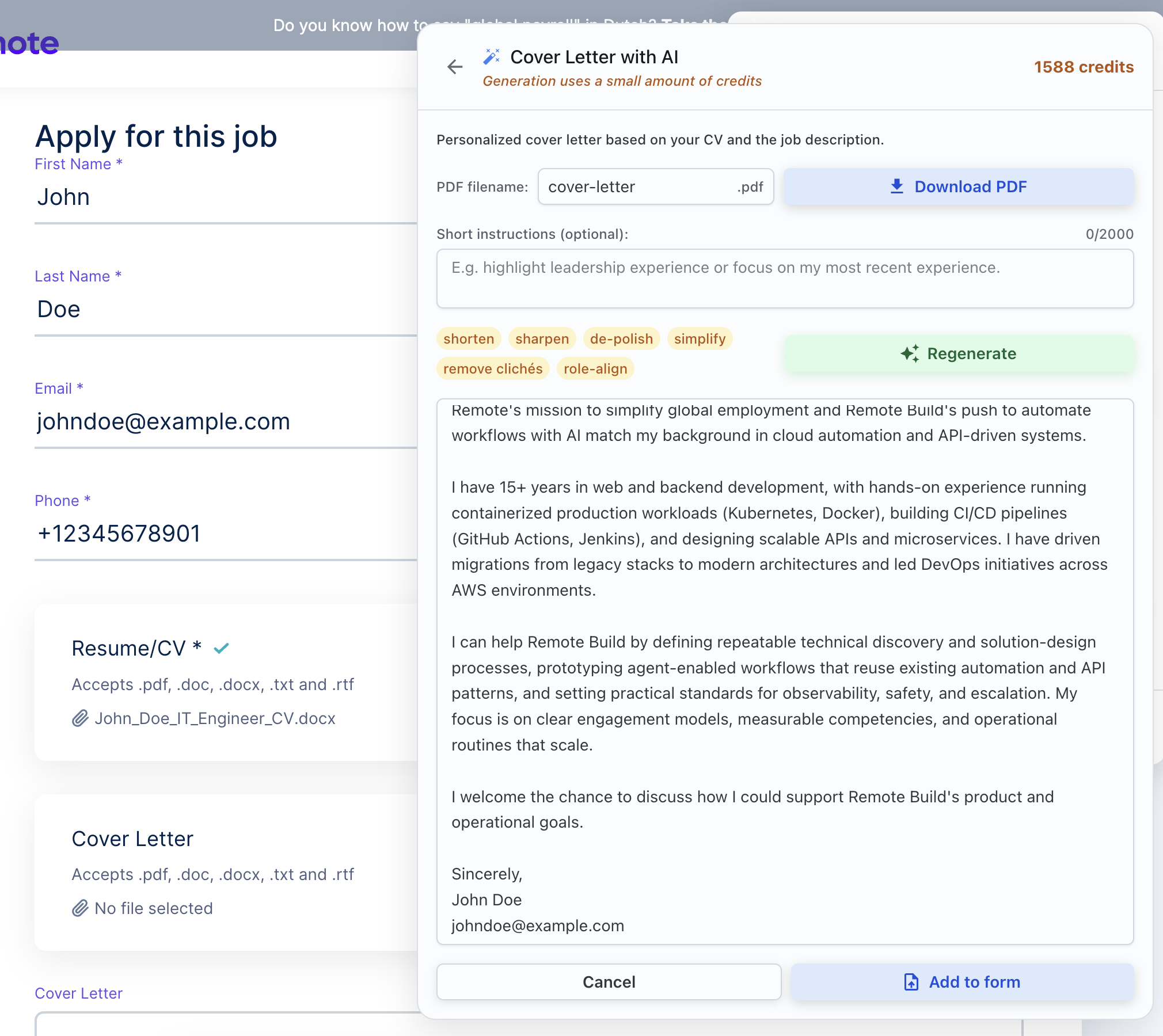
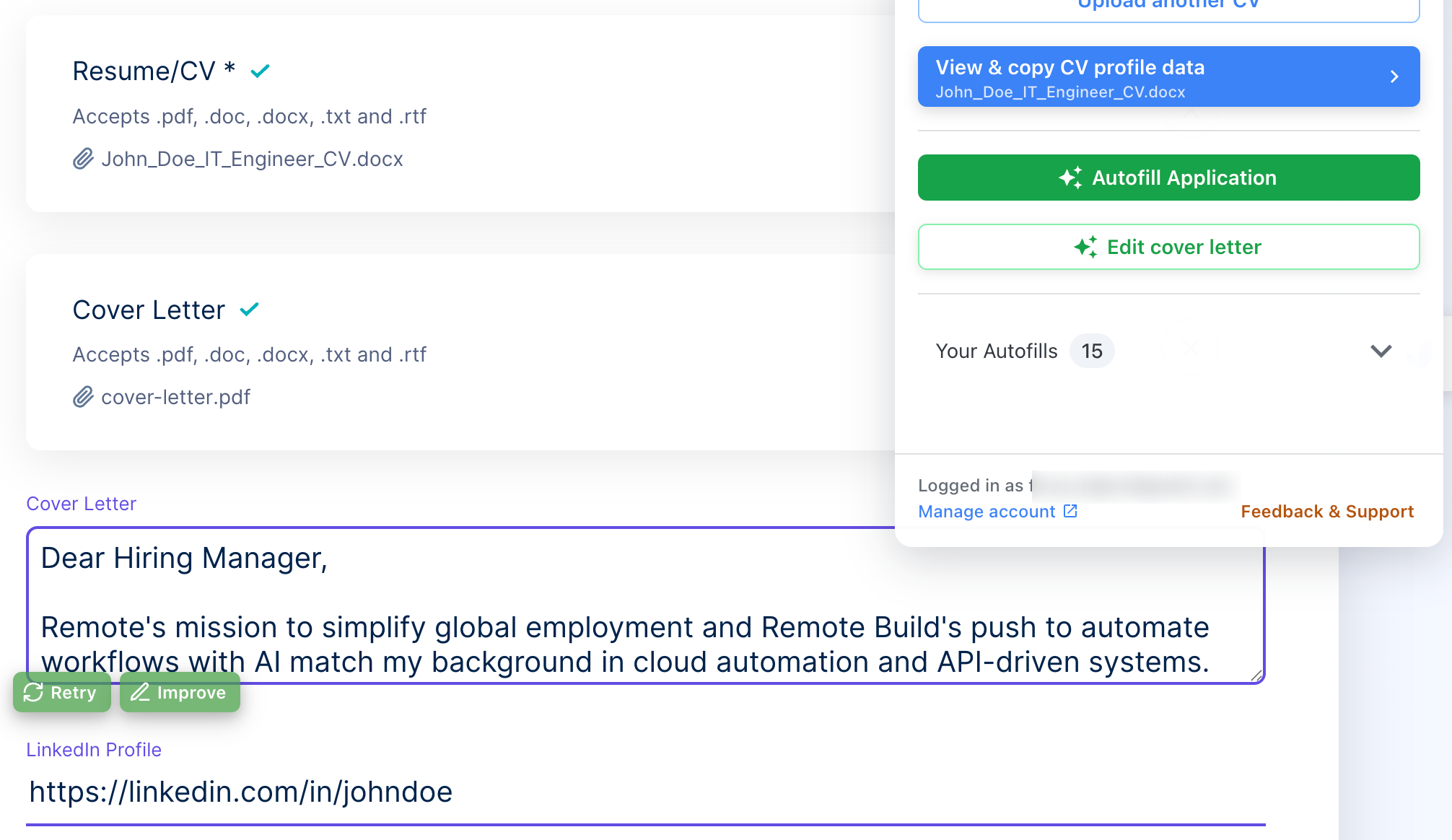
The skeleton-with-swapped-filling approach is exactly what an AI cover letter generator is good at — and exactly where it stops. An AI cover letter generator that works from your CV and the job posting gives you a draft with your real numbers already in place in seconds, so a letter costs minutes instead of an evening. From building ApplyBtn, we've found the draft lands best when it does what the rules above ask: it reads your CV and the posting together, opens on a concrete achievement from your CV, and builds one argument from the posting instead of retelling your resume. What it can't do is know which convention above applies — that a government letter mirrors the announcement word for word, that a hospitalist letter needs a geographic tie, that a data-entry letter leads with WPM. That judgment is yours, and the sections above are the cheat sheet: steer the draft with the role's rules, keep every specific true to your resume, and finish it in your own voice. If you'd rather run it through a chat model by hand, our cover letter prompts for ChatGPT walk through the same recipe.