 By Lucy Vale
AI cover letter template and examples - one honest skeleton, and the 20% no template can fill
Looking for an AI cover letter template? Here's the uncomfortable truth first: the template is exactly what recruiters pattern-match against. Then the useful part - the one skeleton that's safe to reuse, a raw AI-written cover letter next to its edited version, and the edit checklist between them.
Template galleries won't tell you this, so we will: the template is the tell. (A "tell" is the small sign that gives you away.) When recruiters explain how they spot mass-produced cover letters, the signs they name are exactly what a downloadable template is made of. In one HuffPost piece, recruiters listed those tells: a Zapier recruiting manager kept seeing letters that read "Company's mission of [insert mission statement] resonates with me." An Intuit recruiter named the same recycled words showing up on tech resumes — "adept," "tech-savvy," "cutting-edge." A recruitment lead pointed to empty trait-claims with no story behind them, like "excellent communicator" and "team player." An AI cover letter template fills the blanks with all of these at once. The result is polished, identical, and easy to ignore.
So this page does something different from a gallery. You get one skeleton that's genuinely safe to reuse, a real AI-written cover letter shown before and after editing, and a short list of the parts no template can fill in for you.
The skeleton that's safe to reuse
A template only works if you keep the structure fixed and let one part change. That's the whole trick: reuse the shape, rewrite the proof. Here's the skeleton, with the reusable and non-reusable parts marked:
Dear Hiring Manager,
[FIRST SENTENCE — never reusable. Name the job plainly. Then give one true, specific reason you want this role at this company.]
[PROOF — semi-reusable. One or two short stories, each with a real result. Pick them from a small set of accomplishment paragraphs you wrote once. You reuse the paragraphs, but which ones you pick — and how you tie them to this posting — changes every time.]
[COMPANY LINE — never reusable. One sentence that would be false at a competitor: name the product, the market, or the exact problem in the posting.]
Thank you for your consideration — I'd love the chance to talk about the role.
Best regards, [Your name]
What you can safely reuse: the overall shape (three short paragraphs, under a page), the closing, the sign-off, and your set of proof paragraphs. What you can never reuse: the first sentence, the company line, and the reason these proof points fit this job. Every tell recruiters name comes from someone templating exactly those three things.
Sample: an AI written cover letter, raw vs edited
The most useful thing in cover-letter advice is a before-and-after — so here's the AI-era version. First, the kind of draft any tool gives you from a thin prompt:
Dear Hiring Manager,
I am writing to express my strong interest in the Customer Support Specialist position at Fernway. As a passionate and results-driven professional, I believe my skills make me an excellent fit for this exciting opportunity. Your company's mission of empowering customers truly resonates with me.
I am adept at problem-solving and possess excellent communication skills. Throughout my career, I have consistently demonstrated the ability to thrive in fast-paced environments and deliver exceptional results as part of a dynamic team.
I would welcome the opportunity to further discuss how my background aligns with your needs. Thank you for your consideration.
Every sentence is correct English. But not one of them could only have been written by this person for this job. Swap the company name and the letter works anywhere — and that's exactly the test it fails. Here's the edited version: same person, same tool, ten minutes later.
Dear Hiring Manager,
I'm applying for the Customer Support Specialist role at Fernway. I've spent two years answering member questions for a 400-person club — billing mix-ups, complaints, the works — and your posting reads like a description of that job with better software.
The part of support I'm best at is the part that prevents the next ticket: when we migrated membership systems, I wrote the FAQ that cut committee questions to nearly zero in two weeks. Your posting mentions a help-center rebuild — that's the same muscle.
Thank you for your consideration — I'd love to talk about the role.
Here's the edit checklist between the two:
- Cut the generic opener.
- Replace every trait-claim with one story and a result.
- Delete the mission-statement flattery.
- Add the company line that would be false anywhere else.
- Keep the fixed shape.
That's it. The structure survived. The filler didn't.
Does a template letter actually get you rejected?
Let's be honest about the full picture. On job forums, you'll find people who reused one letter for dozens of applications — a few with the wrong company name still in it — and got interviews anyway. Many cover letters are simply never read. But those same forums also have hiring managers who treat that mistake as an instant "no." Both outcomes are real. You can't tell in advance which reader you'll get. So a template letter isn't a sure rejection — it's a bet that nobody reads it. The three non-reusable slots above are cheap insurance: about four sentences of extra work per application. How to tailor a cover letter for each job shows how.
Skip the fill-in step entirely
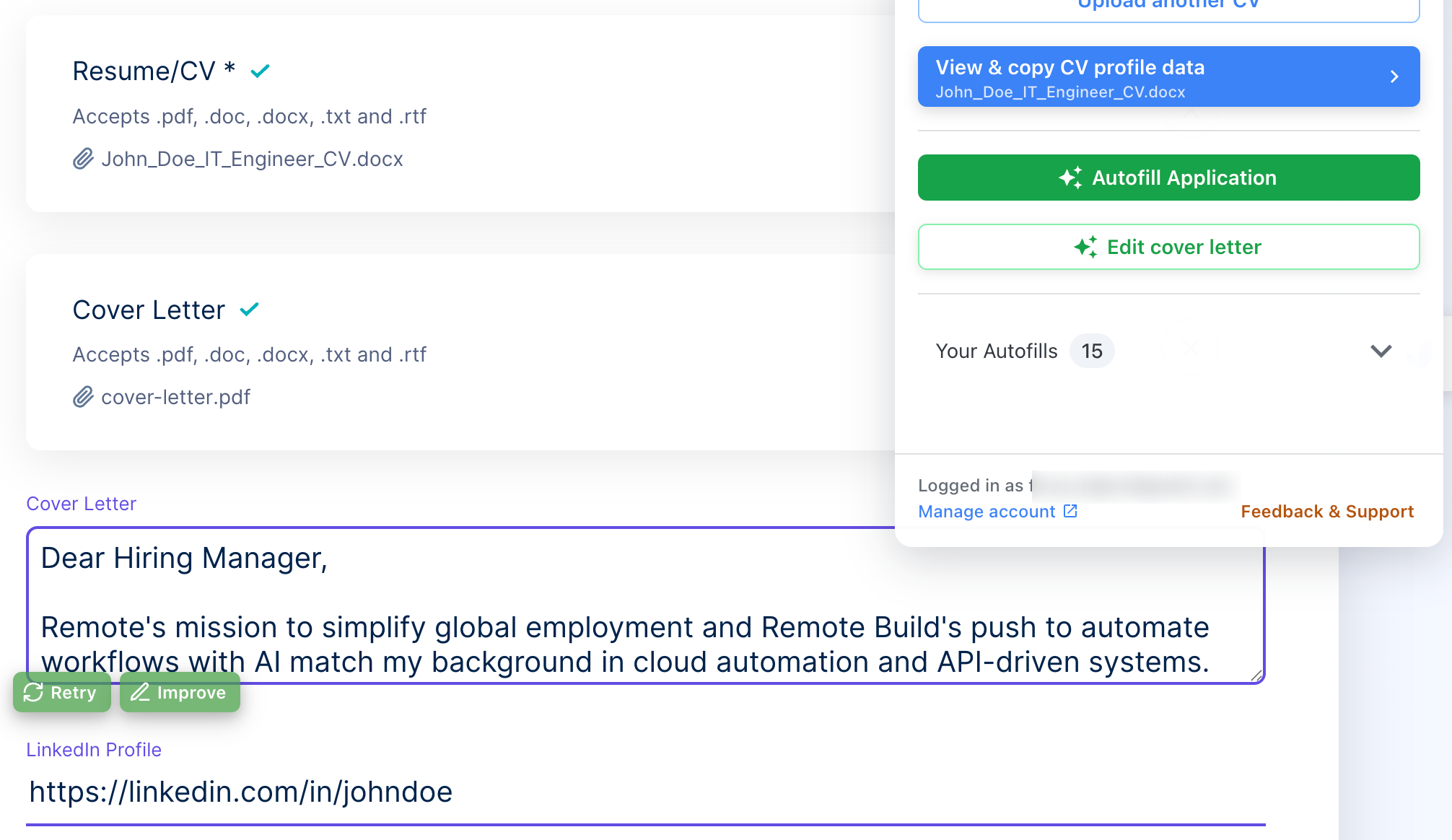
A template with blanks and an AI prompted from scratch fail the same way: neither one knows your real material. What works is generating the letter from your real inputs. An AI cover letter generator that writes from your CV and the job description gives you the skeleton already filled with your experience for that specific posting. That's the whole fill-in step, done honestly — not a blank template you fill in yourself.
That's how ApplyBtn's own generator is built: it reads your CV and the posting together, opens with a concrete achievement from your CV instead of "I am writing to…", and is told to use only what's in your resume — never invented facts. You still own the edit. The company line and your voice are the 20% no tool fills in for you. If you'd rather drive a chatbot yourself, the prompts-based version of this workflow follows the same rule. Either way, run the swap test before you send: if the letter would work at another company, it isn't finished.