 By Lucy Vale
Cover letter prompts for ChatGPT - and why most produce the letter everyone sends
Copy-paste cover letter prompts for ChatGPT that actually produce something specific: a master prompt built on your CV and the job description, refine prompts for the draft, and a prompt for job application questions.
"Write me a cover letter for this job" is the most-typed cover letter prompt for ChatGPT - and it's why so many letters open with "I am writing to express my strong interest…". The model isn't the problem; the prompt is. Ask for a cover letter with no inputs, and you get the average of every cover letter ever written — exactly the letter recruiters skim past.
And "skim past" is the kind outcome. Recruiters say a lot of the letters they read now arrive obviously AI-written, and one giveaway they mention again and again is the letter you could send to ten companies just by swapping the name. Many recruiters won't read the letter at all, and you can't know in advance which ones will — but for the ones who do, it can decide the outcome. So the rule is simple: send something true to this job, or send nothing. Never the generic default.
Good prompts fix this by changing what the model reads before it writes. And because the prompt does the work, these AI cover letter prompts run the same in any assistant, not just ChatGPT. Here's the set worth keeping.
The master cover letter prompt for ChatGPT
One AI prompt for a cover letter does most of the work. Paste it with your resume and the real job description - both, every time:
Write a cover letter for the role below.
JOB DESCRIPTION: [paste the full posting]
MY RESUME: [paste your resume, or the relevant parts]
Rules:
- 250-300 words, first person, plain language.
- Use only experience that appears in my resume. Do not invent or exaggerate anything.
- Reference at least two specific requirements from the job description and connect each to a concrete example from my resume (a project, a number, a named tool).
- No clichés: skip "passionate", "dynamic", "fast-paced environment", "I am writing to express" — and the words recruiters now pattern-match as AI: "leverage", "spearheaded", "resonates", "adept", "testament to".
- The first sentence must mention something specific about this role or company - not enthusiasm.
- Give me two variants with different openings.
The rules are the part people skip - and shouldn't. Without the "only my resume" rule, the model pads. Without the cliché ban, you get the template. Without "two variants", you accept the first draft instead of choosing.
Refine prompts: fix the draft, don't re-roll it
Starting over from scratch loses whatever was already good. Refine instead - each of these is a follow-up prompt on the draft you already have:
Cut this to 200 words. Keep every specific detail (names, numbers, projects); cut adjectives and enthusiasm first.
Replace every generic phrase with something concrete from my resume, or delete the sentence if there's nothing concrete to say.
Rewrite the opening sentence three ways. Each must name something specific about the company or role. No "I am excited to apply."
Vary the sentence rhythm - mix short and long sentences. Right now every sentence is the same length and it reads machine-made.
Here's a paragraph I wrote myself: [paste something you actually wrote]. Rewrite the letter in this voice.
That last one is the most underused, and the most useful. The fastest way to make a generated letter sound like you is to show the model what you sound like. The order matters too: a letter the model wrote from nothing is the kind that reads as AI, while a draft where it only reshaped your own sentences is much harder to spot — and more honest anyway.
A prompt for job application questions - not just the letter
Application forms ask their own open questions - "Why do you want to work here?" or "Describe your relevant experience." The same structure works as a prompt for job application questions. Only the output gets shorter:
Answer this job application question: [paste the question]
JOB DESCRIPTION: [paste it] MY RESUME: [paste it]
Rules: 100-120 words, first person, one concrete example from my resume, mirror the job description's own vocabulary where honest, no filler openings like "I believe that".
Answers get an even quicker read than letters - a few seconds, in the middle of filling out a form. Specific beats polished. For this kind of question, the default ChatGPT answer is easy to spot: recruiters report seeing the same shape again and again, something like [Company]'s mission of [mission statement] resonates with me and my experience in [current role]. If your answer lands in that mold, it reads as generic no matter how clean it is. Name one specific thing about the company and tie it to one thing you actually did. (This per-question workflow is what a job application answer generator does for you in place - same inputs, generated inside the form field itself.)
The rules that keep it honest
Whatever the prompt produces, run three checks before you send it:
- Check every claim against your real resume. The model fills gaps with confidence, but you're the one signing the letter. If you couldn't defend a sentence in an interview, delete it. And don't write to beat an AI detector - these tools get it wrong both ways, flagging real human writing as AI and passing AI text as human, so gaming the score only makes the letter worse. The only read that counts is the human one, and specific detail is what survives it.
- Rewrite the opener in your own words. It's the sentence people read most, and the one that most often sounds like a template.
- Read it aloud once. Even, same-length sentences and empty polish are the signs that make a letter read as AI-written - we broke them all down in how to check if a cover letter is AI generated. Fixing those signs is the same work as making the letter good.
When you'd rather skip the copy-paste
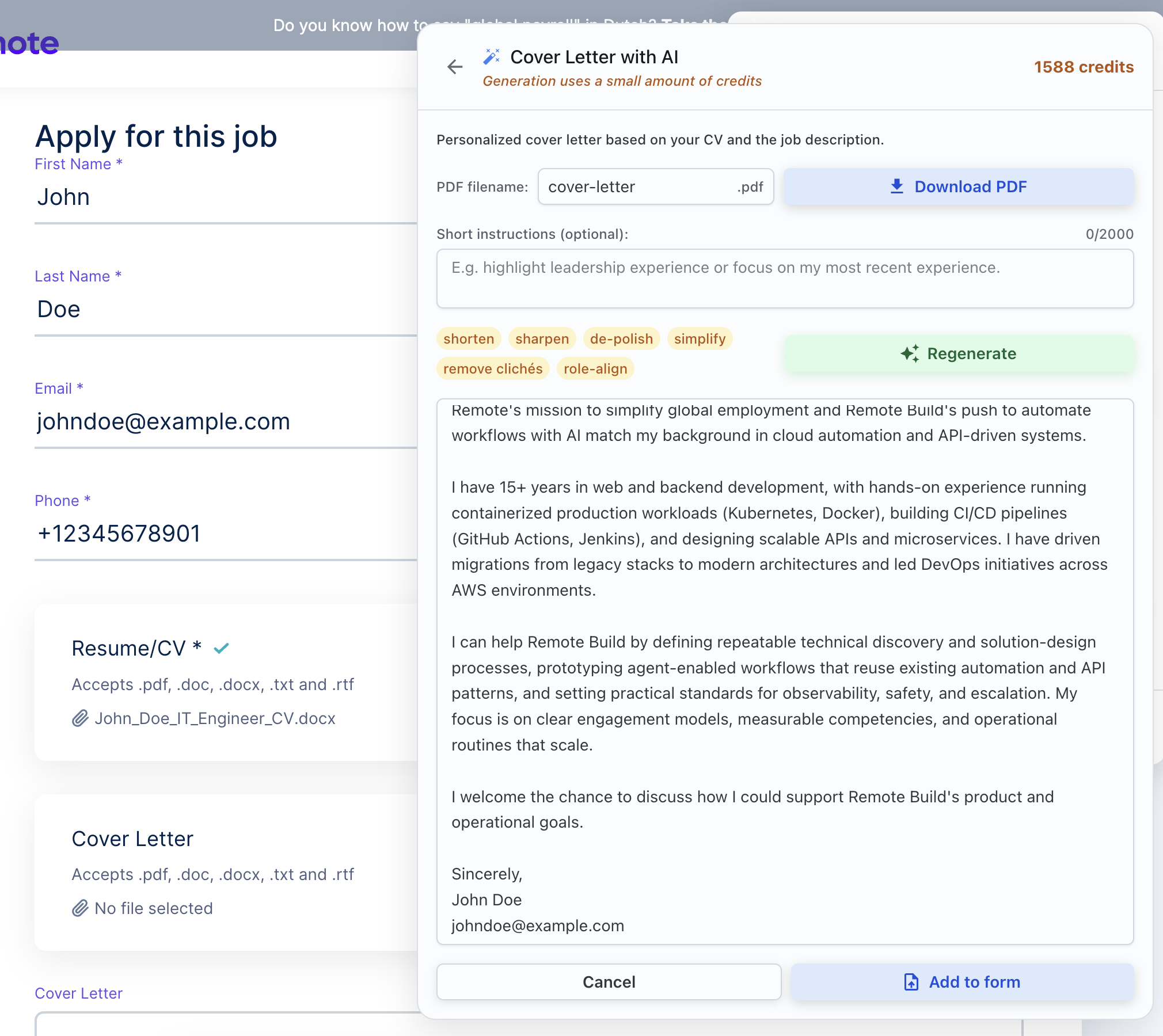
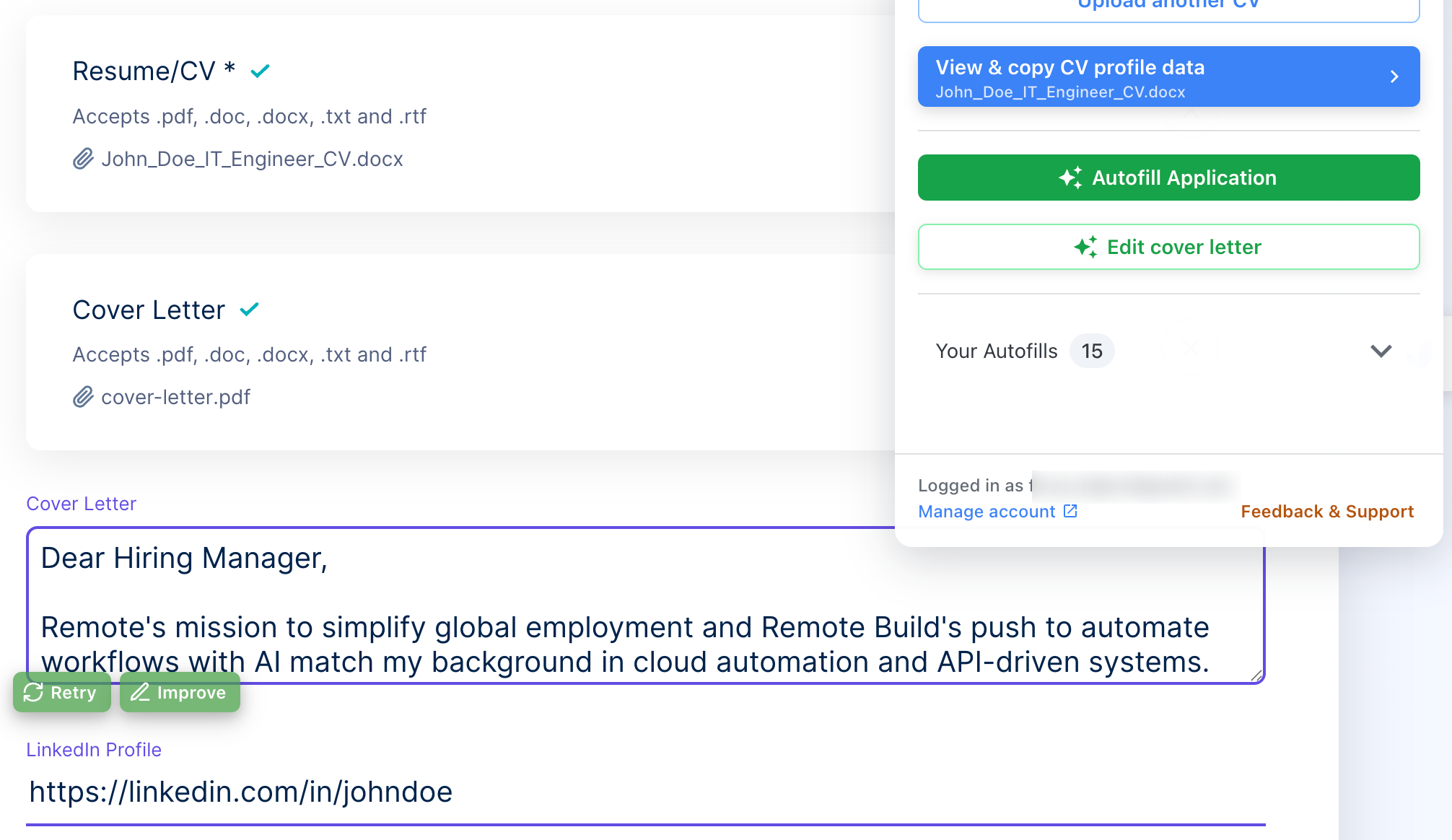
Notice what the master prompt really is: your CV, plus the job description, plus the tailoring rules - re-pasted for every single job. That copy-paste work is the price of doing it in a chat window, and it's exactly the part an AI cover letter generator that reads your CV and the job description automatically removes. ApplyBtn runs the same recipe inside the application form itself: your uploaded CV and the job page it can already see, a short-instructions box when you want to steer it, refine controls on the draft, and your own edit before anything is sent. And it keeps the rule at the heart of this guide: in our experience building it, the generator writes the draft from only what's in your resume, so you refine real detail instead of deleting invented claims. Same discipline, none of the pasting - free to start with welcome credits.
Either way, the standard is the same: specific to this job, true to your resume, and finished in your voice.