 By Lucy Vale
How to tailor a cover letter for each job - the 15-minute method that beats a full rewrite
How to tailor a cover letter to the job description without rewriting it every time: how to decide which applications even deserve a letter, the two or three requirements worth proving, and a swap test that tells you whether it's actually tailored.
Most advice on how to tailor a cover letter for each job assumes you should rewrite the whole thing, every time, for every application. That advice is why cover letters feel like such a chore, and why a lot of people give up and send the same generic page everywhere. The smaller, less tiring version: decide which applications deserve a letter at all, then change about four sentences. That's tailoring. The rest is just extra work.
Two things are true at the same time, and any guide that hides one of them is selling you something. First, many hiring managers say they never read cover letters — especially at big tech companies and in other high-volume hiring, where managers and engineers openly say they skip them. Second, when someone does read it, a letter that clearly fits the role tends to do better than a generic one. So the skill isn't tailoring harder. It's knowing which few applications deserve the effort, and spending it there.
Does tailoring a cover letter to the job description actually work?
The one controlled experiment people point to is a 2019–2020 field study by the résumé-writing company ResumeGo. It sent 7,287 fake applications to real job postings in three versions: no cover letter, a generic letter, and a letter tailored to the job. The callback rates were 10.7% with no letter, 12.5% with a generic one, and 16.4% with a tailored one. Treat these numbers with care: it's a single study, it's a few years old, a résumé company ran it, and the applicants weren't real. Still, the pattern matches what hiring managers describe — the tailored letters did best, and the generic ones still beat sending none. And the bigger jump was from a generic letter to a tailored one (12.5% to 16.4%), not from no letter to a generic one.
Here's the part the templates won't tell you: very few people write a truly tailored letter. In hiring-manager discussions on Reddit and forums like Ask A Manager, the people who read letters say most just repeat the resume as paragraphs. So a clear, error-free letter that answers this posting can stand out. That's what readers say, not a measured number — but it points the same way as the study. You're not competing against great cover letters. You're competing against the same recycled page everyone else pasted in.
First, decide which jobs get a tailored letter
Before you tailor anything, sort your applications. A tailored letter pays off in some places and does almost nothing in others. If you pretend otherwise, you'll end up hating the whole task.
Worth the 15 minutes:
- Small companies, startups, mission-driven organizations, and any place where a human clearly reads applications.
- Roles where writing is the job, or close to it.
- Any application where your resume raises a question — a gap, a short job, a career change, a move to a new city, or looking overqualified. This is the case where a letter helps most (more on it below).
- Postings that require the letter, rather than an optional upload.
Usually not worth it:
- High-volume hiring with an optional letter field and a resume that already matches — the letter often never reaches a decision-maker.
- Government and federal roles, where the letter is often only reviewed if the posting lists it as a required document; otherwise the structured resume and questionnaires usually carry the decision.
If you skip the letter on a low-payoff application, that's a strategy, not laziness. Save the effort for the postings where a person will actually read it.
How to tailor a cover letter to the job description
Once you've decided a posting deserves a letter, the method is the same every time. It's fast because you're editing, not writing from scratch.
Build the base once. Keep one solid base letter and a small set of four or five proof stories. Each one is a real thing you did, with a result attached. To tailor the letter for a new posting, you swap in the right two or three. You don't rebuild the page.
- Pick two or three requirements — not all of them. Read the job posting and choose the two or three requirements you can prove best. Write one specific sentence for each, with a real example: a project, a number, a tool you used. Three sharp claims beat a paragraph of "I have strong X skills."
- Use the posting's own words. Use the same nouns the job description uses for the tools, tasks, and skills — not to game any software, but because it's the clearest sign to a human reader that you actually read the posting.
- Run the swap test. This is how you know it's tailored. Write at least one line that would be nonsense if you pasted it into another company's letter. Compare:
I'm excited to apply for this role. I'm a hard worker with strong communication skills and a passion for the industry, and I'd be a great fit for your team.
That works for any job at any company — which is exactly why it does nothing. Now:
Your posting leads with migrating the billing system off Stripe before renewal season. I ran that same migration at Acme last year, and the tight cutover window you describe is precisely where it nearly went wrong for us.
Put another company's name into the first, and you can send it anywhere. The second one doesn't work anywhere else. If your whole letter passes the swap test — if nothing in it is specific to the company — you haven't tailored it yet. You've just changed the greeting.
That's the whole job when you tailor a cover letter for a specific job: two or three proven requirements, the posting's own words, and one line that could only be written for this company.
What a tailored letter should actually say
Here's a reframe that makes tailoring easier: treat the cover letter as a place to explain the unusual things on your resume, rather than as a general sales pitch. Often a hiring manager opens the letter because the resume raised a question — a gap, an unusual career path, a change of field — and they want the story before they decide. So write the letter for that question.
If your resume raises no questions, your letter matters least. Add a couple of tailored sentences and move on. If it raises one, that letter is doing the most work in your application. Its job is to answer what the resume can't: why the gap, why the change, why you want this role now. Don't repeat the resume — the reader already has it. Say only what it can't.
Tailoring a cover letter with AI - and the part you can't skip
You can tailor a cover letter to the job description with AI, and for the first draft you probably should. It's the fastest way to get your real experience onto the page in the posting's language. But the finish is yours, because a letter that reads like pure machine output can hurt you on its own. On hiring forums, recruiters say they can spot the signs: words like delve, leverage, spearheaded, testament to; the same four-paragraph shape; the "I am writing to express my interest" opener. The pattern in those discussions isn't that AI use gets rejected — it's that generic writing does: a letter that reads like every other one that day.
There's now academic research pointing the same way. A 2025 study of one hiring platform that added an AI cover-letter tool (a preprint, not yet peer-reviewed) found that employers there soon trusted these letters less. After the tool launched, the link between how well a letter matched the posting and how often it got a callback dropped by about half. But applicants who spent time editing the AI draft still did better. The first draft is cheap now; the editing is the part that still counts.
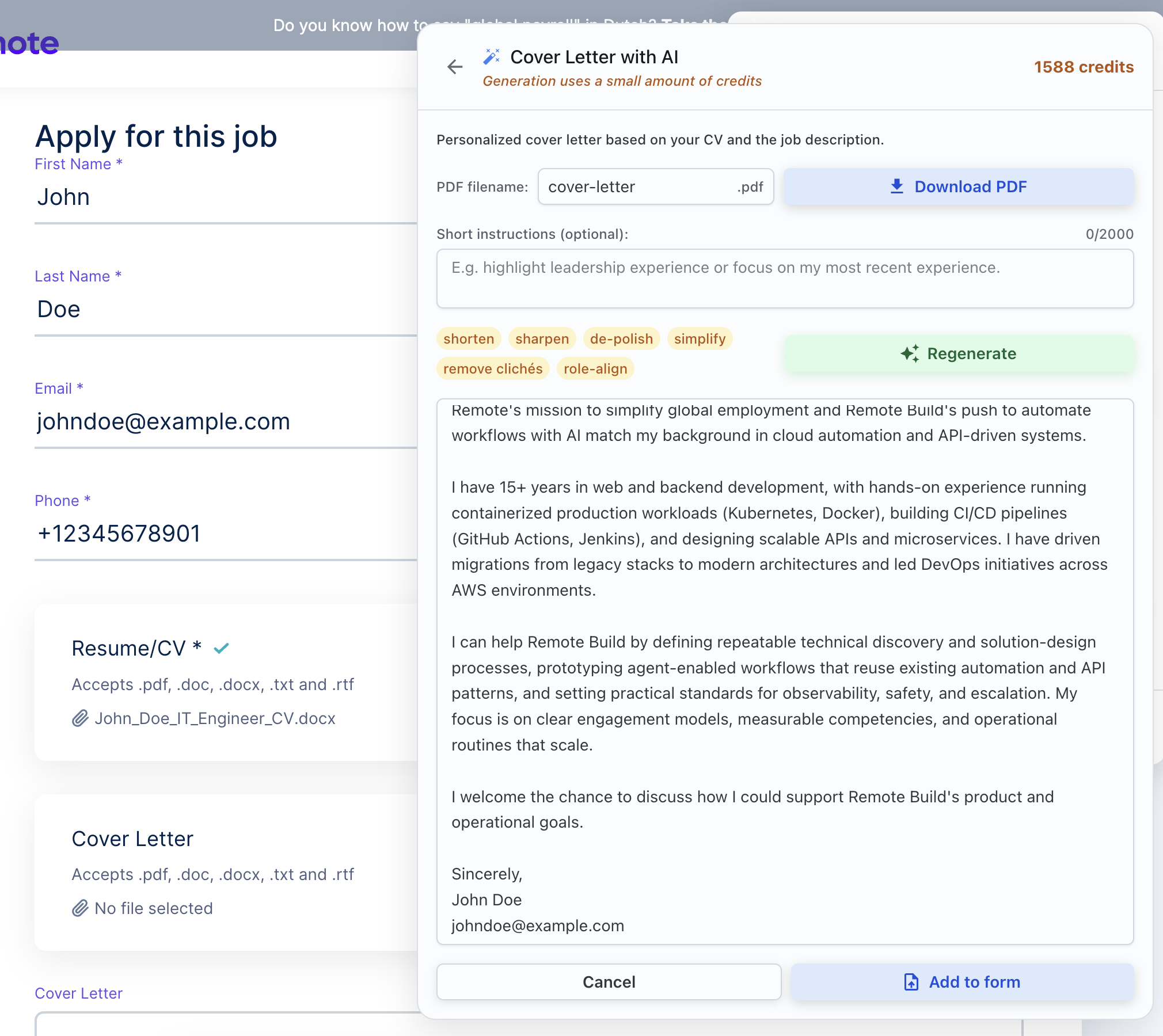
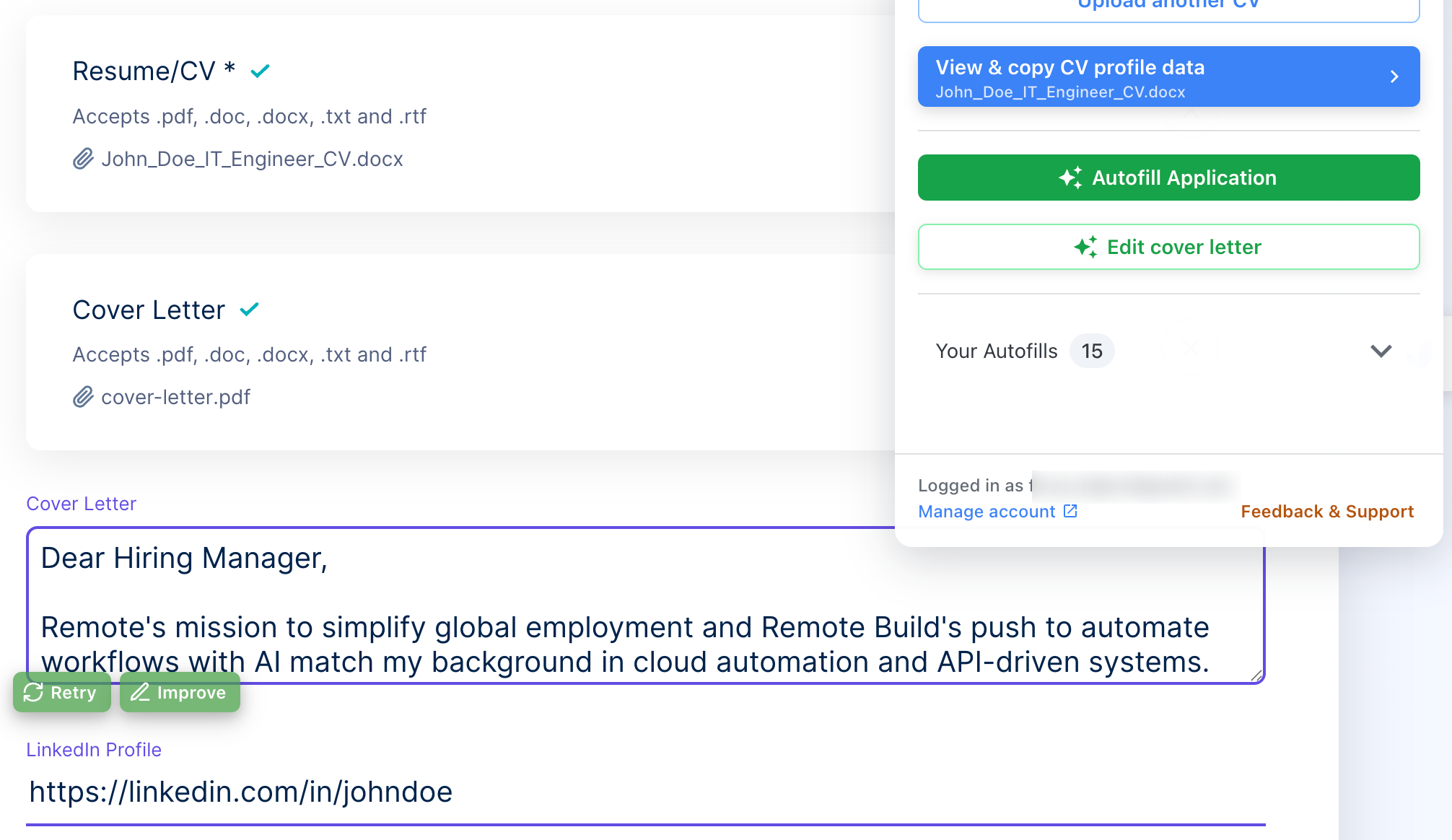
So let the tool write the first draft, and spend your time on the four sentences that matter — the two or three proven requirements and the one line that only fits this company. An AI cover letter generator that works from your CV and the job description writes the base with your real details already in place. The editing step is where you remove the AI signs and put it in your own voice. If you'd rather do it yourself in a chat window, our cover letter prompts for ChatGPT follow the same steps — with the "use only what's in my resume" rule that keeps it honest.
That last step — choosing which two or three requirements to prove — was the hardest part to automate when we built ApplyBtn's own cover-letter generator. It reads your CV and the job posting together and writes the first draft. But when we review its drafts against the real CV and posting, the issue we run into isn't bad writing. It's the wrong choice: with a long CV, it can lead with your most impressive experience instead of the one this job actually asks for, and it can miss a requirement the posting stated clearly. Choosing the experience that fits the job is the judgment we leave to you — the same "pick two or three requirements" step this whole method is built on.
The 15-minute checklist
When you've decided a posting deserves a letter, this is the whole method:
- Sort first — will a real person read this one? If not, skip it.
- Pick 2–3 requirements you can prove, with one concrete example each.
- Use the posting's own words for the tools and tasks.
- Write one line that only fits this company — pass the swap test.
- Answer the question your resume raises, if it raises one. Don't repeat the resume.
- Remove the AI signs — cut the tell-words, break the four-paragraph pattern, and read it aloud so it sounds like you.
A few genuinely tailored letters, aimed at the jobs where someone will actually read them, are usually a better use of your time than one generic letter sent everywhere. Once your base letter exists, each one is mostly editing. If you're working through a batch, our cover letter examples by role show the conventions to borrow for your field, and the AI cover letter generator writes the base so your time goes where it counts — the parts only you can write.