 By Lucy Vale
Cover letter with no experience - what to write when you have no track record yet
A cover letter with no experience can't point to past jobs - so it has to do a different job entirely. Here's the structure that works, a full example letter, and the three substitutes for experience that hiring managers actually accept.
Every cover letter guide says the same thing: point to your past jobs, put numbers on your wins, name your projects. Good advice — unless you're writing a cover letter with no experience to point to. First job, career switch, fresh graduate: the standard template doesn't just fit badly, it works against you. Follow it and you produce a page of filler that points straight at the thing you'd rather the reader not notice — that you haven't done this before.
The fix isn't to hide the gap. It's to change what the letter argues.
Two honest points before the how-to. Yes, many recruiters skim or skip cover letters. In HR and tech forums, people often say they never open them, and that a generic one turns from "no opinion" into an instant "no". But those same discussions say the opposite for people in your position: when the résumé has no track record to carry you, the letter is often the only thing that makes you stand out. So thin experience is exactly the case where the letter matters most — and where a lazy one hurts most.
What a no-experience letter argues instead
A normal cover letter argues "I've done this before." Yours argues "here's the evidence I'll do it well" — and there are three kinds of evidence that don't require a job title:
- Proof of the skill, wherever it happened. A course project, a volunteer role, a club you ran, something you built or organized or fixed outside any job. The hiring manager doesn't need the skill to have come from a paid job — they need it to be real and something they can check. One concrete story with a result beats five adjectives.
- Proof you understand the actual job. Most no-experience letters are generic because the writer has nothing specific to say. Do the opposite: read the job posting closely and answer it. Name the tools, the type of customer, the exact task — and link each one to the closest thing you have done. Being specific looks like competence, even before you have a résumé to prove it.
- Proof you're cheap to train. What every manager fears about a new hire with no experience is the cost of getting them up to speed. Show you've already started: a course finished, a tool learned at home, the industry reading you actually did. "I've already set up X and worked through Y" is worth more than any sentence with the word "passionate" in it.
Finding that story is the real work. This is where people freeze, sure that a summer job and a part-time gig add up to nothing. But people who've done this well keep making the same point: an ordinary job is full of the skill if you look at the moment, not the title. The fast-food shift where you calmed a furious customer is conflict resolution. Covering other people's shifts is organizing a team. A cashier who made the queue move faster improved the customer experience. Pick one moment like that and tell it in order — what was happening, what you did, what changed — and add a number to the result if you have one.
And one rule about structure: never apologize. A line like "Although I don't have any professional experience…" hands the reader the objection in your own words. Say what you bring; let the résumé show the dates. This is the one thing people in these discussions almost all agree on: don't open by listing your weak points. A comparison that comes up a lot: a cover letter is a bit like a love letter, and nobody opens a love letter by admitting they're a terrible kisser who's bad with money. If your thin experience really does need to be discussed, that belongs in the interview, out loud — not in a sentence you hand the reader yourself.
Cover letter with no experience — example
A recent graduate applying for a junior customer support role:
Dear Mr. Osei,
I'm applying for the Junior Customer Support role at Fernway. I finished my communications degree in June, and the work I did alongside it is the closest thing to this job I could have chosen: two years answering member questions for my university's 400-student climbing club, where I was the first point of contact for everything from billing mix-ups to safety complaints.
That role taught me the part of support that doesn't show up in a syllabus: staying calm with someone who's frustrated, writing answers that prevent the follow-up question, and knowing when to stop typing and escalate. When we switched membership systems last year, I wrote the FAQ that handled the transition — questions to the committee dropped to almost none within two weeks.
Your posting mentions Zendesk and a help-center you're rebuilding. I've spent the past month working through a free Zendesk trial, so I'd arrive knowing my way around macros, views, and tags rather than learning them on your time — and the FAQ work above is exactly the muscle a help-center rebuild needs.
I'd be glad to talk about the role, and I can share the transition FAQ I wrote if it's useful.
Best regards, Daniel Reyes
Notice what it never does: apologize, mention the missing years, or use the word "opportunity." Every paragraph is one of the three substitutes — the club story is proof of skill, the Zendesk paragraph is proof he's cheap to train, and the posting details show he read the actual job.
Adapting the example
Keep the structure and swap in your own material: one real story where you used the core skill (any setting counts — a class project, volunteering, a family business, a personal project), one specific detail from the posting answered directly, and one thing you've already learned or set up in your own time. If you honestly can't fill that third slot, fill it before you apply — a free course or a free trial account takes an evening and gives the letter its strongest paragraph.
Career switchers: the same structure works, but your first piece of evidence is stronger — you have proof from a real job, just in a different field. Lead with the story that transfers, and spell out the link ("calming a furious parent as a teacher is exactly the de-escalation this role describes").
Writing it faster
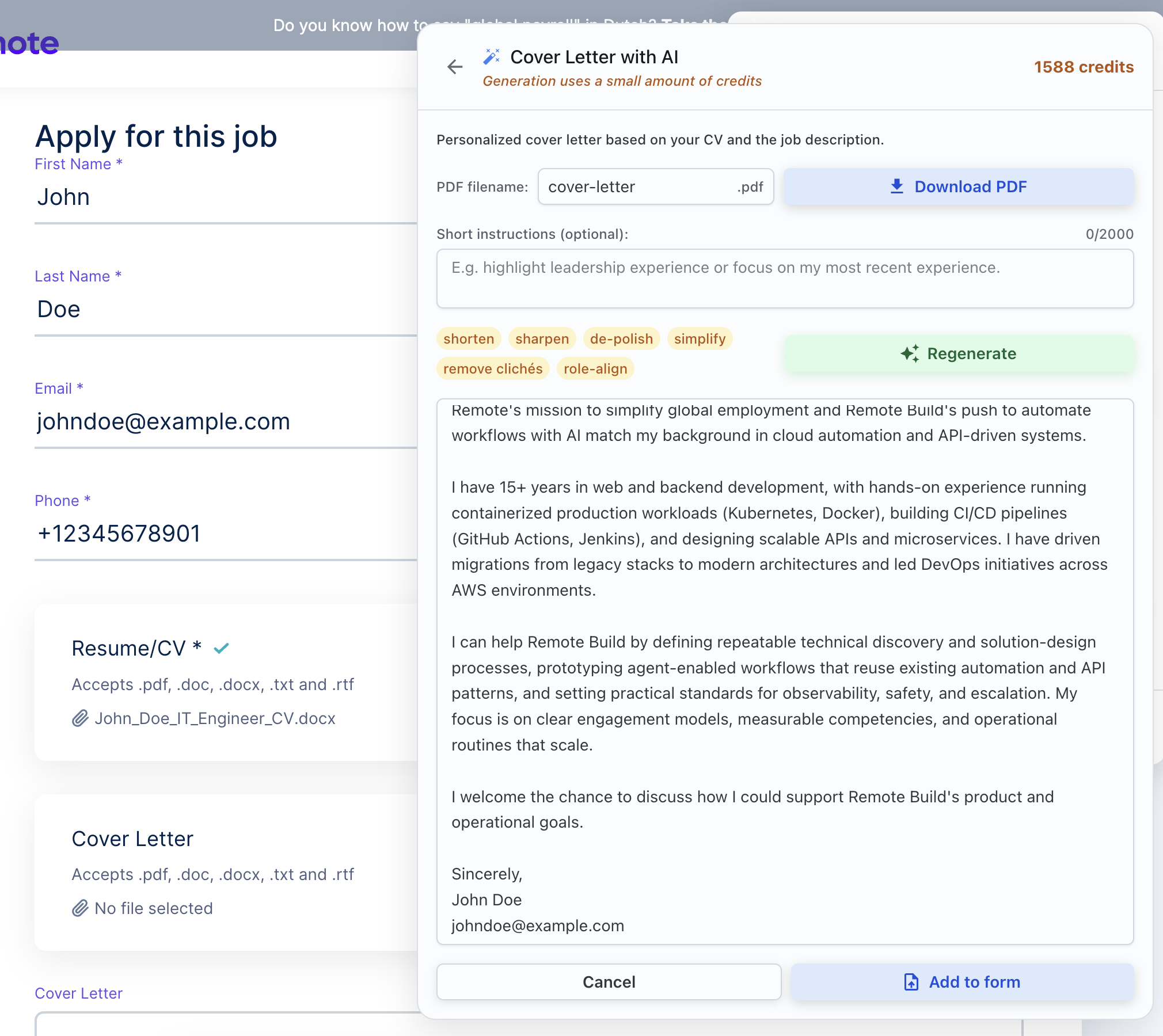
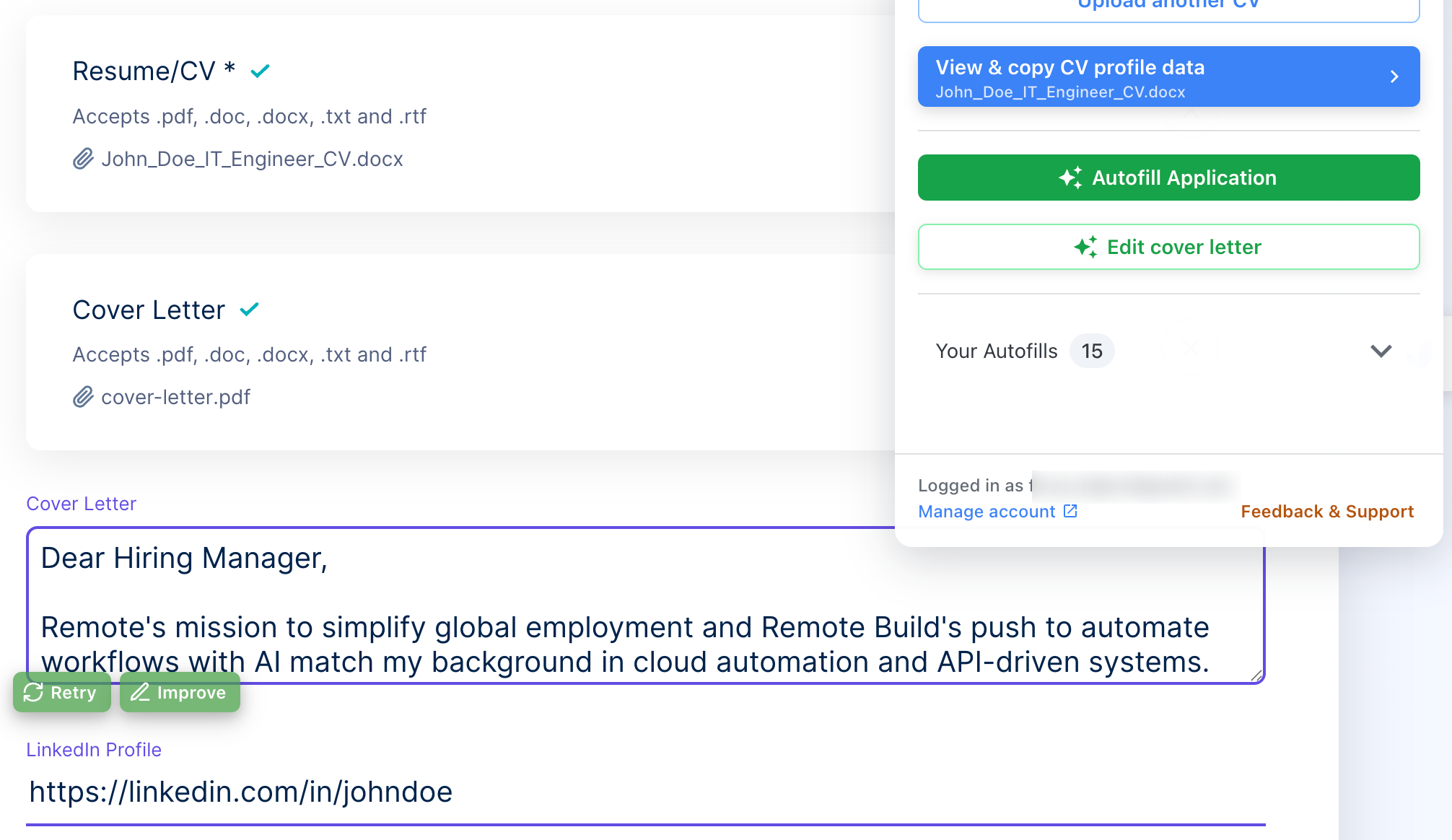
The hard part of a cover letter with no experience is deciding which of your non-job stories carries the argument — no template does that for you. But once you know the story, the drafting doesn't have to be manual. An AI cover letter generator that works from your CV and the job posting builds the structure with your real details already in place, so you can spend your effort on the two paragraphs that matter: the story, and the proof you're already learning.
That split matters more than it sounds. In recruiter and hiring forums, people often say a fully machine-written letter is easy to spot — it reads like every other one they've seen that week — and that a pure-ChatGPT letter is more likely to be skimmed and dropped than read closely. Treat that as forum wisdom rather than a hard rule, but the safe move is the same either way: let the tool build the scaffold fast, then make the story unmistakably yours. A three-sentence opening in your own voice beats a polished page the model wrote for you.
This is also where a rule we build into ApplyBtn's generator earns its place: we tell it to use only what's in your CV and never invent a job or a result you didn't list. In our experience that matters most when your experience is thin — an unconstrained model is happy to fill a gap with something that isn't true, and a made-up line is the one thing a no-experience letter can't survive. So the draft stays honest, and it's on you to add the real story.
If you'd rather steer ChatGPT through it yourself, our cover letter prompts run the same workflow in a chat window — same honesty rule, and the same trick of pasting in a paragraph of your own writing so the model refines your voice instead of replacing it.