 By Lucy Vale
How to use AI to write a cover letter - without sending the letter everyone else sent that day
Using AI to write a cover letter is normal now - and most people do it in a way recruiters spot in one line. The workflow that survives: feed it your real material, hand it the two things it can't know, and edit until the letter couldn't go to any other company.
Using AI to write a cover letter is normal now. Almost everyone does it. Some recruiters say a lot of the letters they read are clearly written by AI - the same "your company's mission resonates with me" opener, the same five paragraphs, the same flat voice. (That's their impression, not a measured number.)
But here's the part that matters. When recruiters tell you about a letter they rejected, the problem is almost never that AI helped write it. The problem is that nobody edited it: the wrong company name left in the text, a [Company Name] placeholder still there, ten people sending the exact same paragraphs. Recruiters aren't rejecting AI. They're rejecting lazy work.
So the real question isn't whether to use AI to write a cover letter. It's how to use AI to write a cover letter that could only have come from you. That takes a process, not a clever prompt.
What the model can't know (and why "write me a cover letter" fails)
The best argument against AI cover letters is simple. A good letter runs on personal details the AI doesn't have - so asking it to write one from nothing isn't really about ethics; it's about whether it even works. That's true. But the fix is easy: give the AI those details yourself.
Give an AI nothing to work with, and it writes the average of every cover letter ever written - exactly the kind recruiters skim past. It can also do something worse. When the prompt is thin, these tools fill the gaps by inventing things: skills, tools, even results you never mentioned. That letter can pass the first screening and then fall apart in the interview, when you can't back up a paragraph you didn't write. Recruiters on hiring forums describe this a lot - a perfect-looking application, and a candidate who can't stand behind it in person.
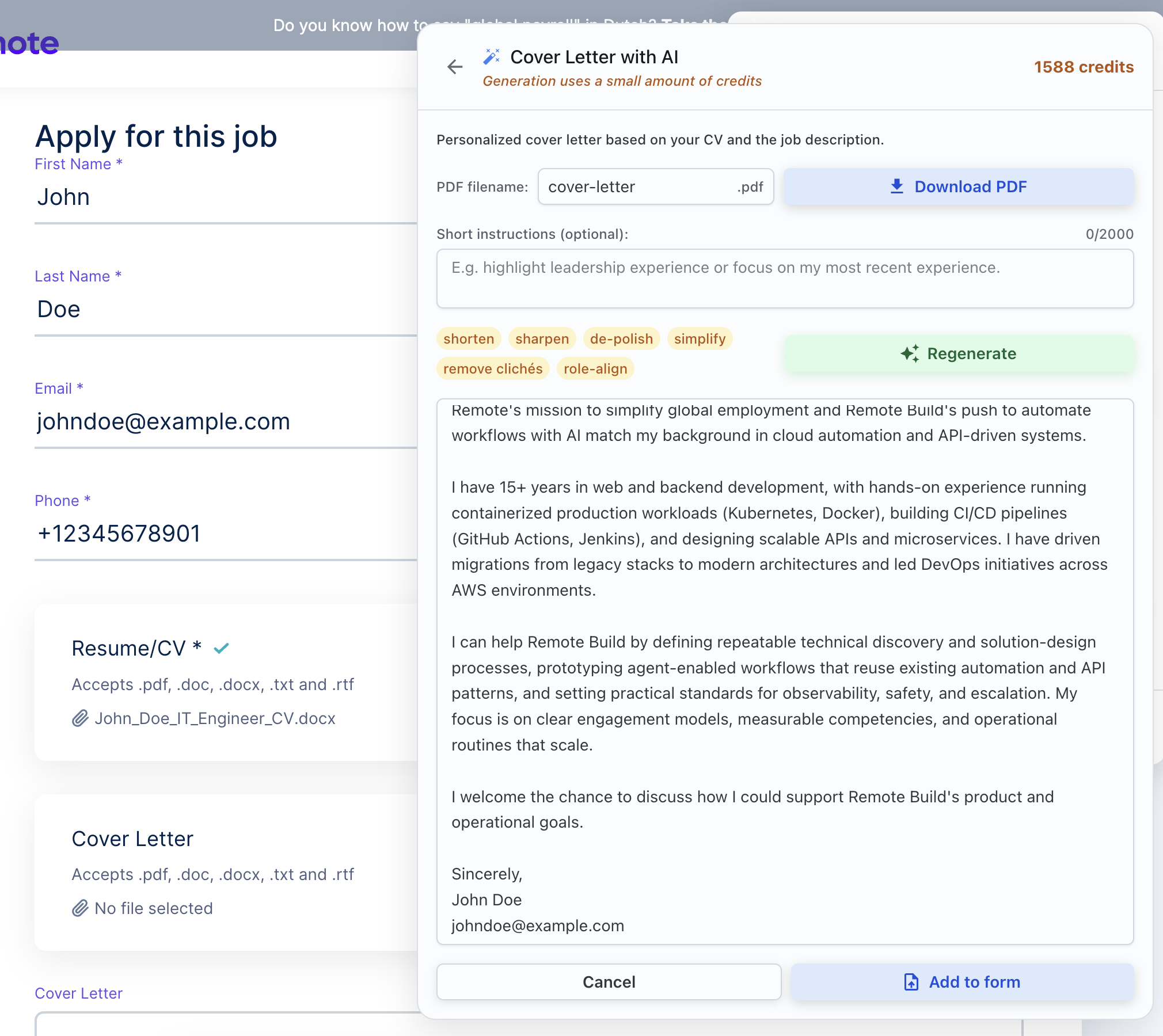
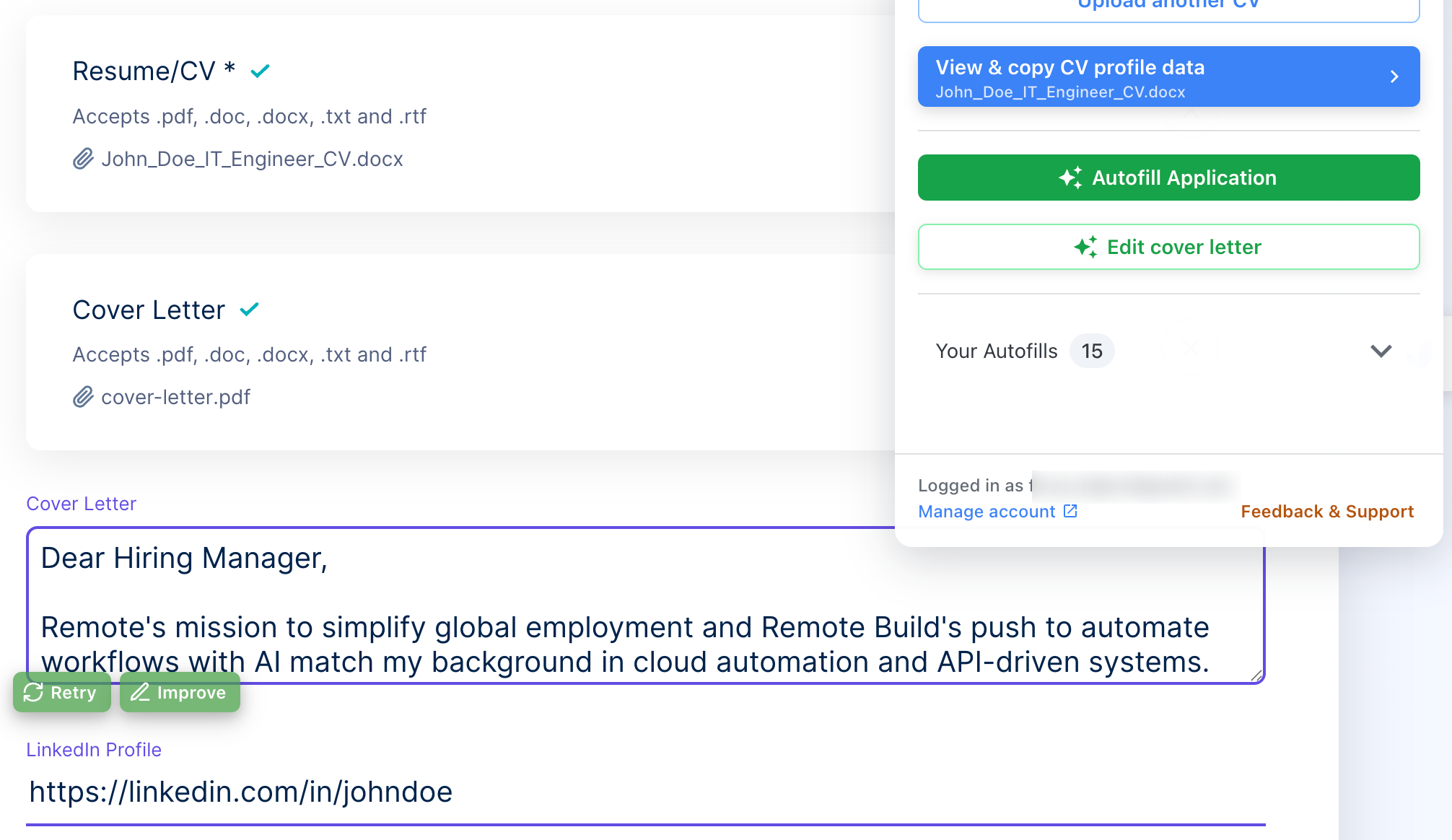
This is the one thing we were strictest about when we built ApplyBtn's own cover-letter generator: it uses only what's in your CV. If a skill isn't in your resume, it won't put it in the letter. In our experience, that one rule is what prevents the invented-skill problem in the first place.
Everything below is there to close that gap.
How to write a cover letter with AI, step by step
This is the process that shows up in the stories where AI actually helped: the person fed the model their real experience, edited the draft, and sent something specific. What those stories share isn't a clever prompt. It's what people put in, and what they checked before sending.
- Give it your real material - both parts. Paste your actual resume and the full job description into the same request. The stories where AI helped all did this. The "it wrote me a generic letter" complaints all skipped it. This one step changes the quality the most.
- Add the two things it can't know. First, why this company in particular - a product, a market, something real. Second, one true story or project that fits the role. The AI writes the draft; you bring the substance. Without these two things, hitting "regenerate" won't help.
- Keep the draft tight. Ask for something short - the same five-paragraph shape everyone uses is itself a giveaway. No repeating the resume. No skills you didn't give it. Plain language, too: stiff, over-formal English is one of the signs hiring managers name.
- Question it before you edit. Cut every claim you couldn't defend in an interview. Check the company name and the job title. Look for leftover placeholders - and yes, sometimes even your own prompt text left in the letter.
- Make it sound like you. Rewrite the opening line in your own words. Mix up the sentence lengths. Add the one detail no other applicant could write. Then run the test: could you send this same letter to a different company without changing anything? If yes, it's not finished.
- Start a fresh chat for every application. Almost every wrong-company-name disaster comes from reusing an old chat or an old template.
- Don't let the letter oversell you. Write at a level you can keep up in a real conversation. Recruiters notice the gap between a polished letter and the person on the call.
Where to do it: chatbot or generator
There are two ways to write a cover letter online with AI: a general chatbot, or a tool built for the job. To be honest, the tool matters least. The process above matters more.
A general chatbot works if you drive it carefully: paste your CV and the posting every time, keep the output tight, start a fresh chat each time. Our cover letter prompts for ChatGPT are that exact process, ready to copy and paste. The downside is the effort: copy the CV, copy the posting, copy the result back into the form, then do it all again for the next job. That effort is exactly what pushes people into the shortcuts - reusing an old chat - that leave the wrong company name in the letter.
Purpose-built generators get mixed reviews, and users are blunt about the bad ones: stuffed with buzzwords, random keywords copied from the posting, generic text hidden behind a paywall. What a good generator does well is remove the effort that causes the classic mistakes. An AI cover letter generator that reads your CV and the job description automatically starts every letter from your real material, for that exact job - so steps 1 and 6 are handled for you, with no old chat to leave the wrong company name in. The steps no tool can do for you are 2 and 5: the real company-specific line, and the edit into your own voice. Skip those, and even the best generator gives you the same letter everyone else sent.
To generate a cover letter that holds up when a real person reads it, be honest about the time: seconds for the draft, about ten minutes for the checks and the edit. People who ask how to generate a cover letter often mean "how do I skip the ten minutes." But the ten minutes is the part that works.
Will they know AI wrote it - and does it matter?
You'll see surveys where recruiters say they can spot AI writing. Ignore the exact percentages - they're what recruiters believe, not what anyone measured against real AI-written and human-written letters side by side. Here's what's easier to trust: recruiters reliably spot sameness - the stock opener, the mission-statement line, the resume repeated as paragraphs - because they see it dozens of times a day. The problem was never that a machine helped. It's that the letter looks like every other one.
There is some real research here now. A 2025 study of a hiring platform that added an AI cover-letter tool - a preprint, not yet peer-reviewed - found that after the tool launched, the link between how well a letter matched the job and how often it got a callback fell by about half. In plain terms: once everyone could produce a well-matched letter with one click, employers trusted that signal less. But the applicants who spent time editing the AI draft still did better. The draft is cheap now. The editing is what still counts.
So stop worrying about AI detectors and em dashes. Whether your letter reads as AI-written is a writing problem you can fix, not a technology problem. We've broken down how to check if a cover letter is AI generated from both sides of the desk - including why the detector tools themselves aren't reliable.
One last honest note: a cover letter - AI-assisted or not - is rarely the whole game. In the stories where AI really paid off, the letter was the fastest part. The same people also did the slower work: they reached out to the hiring team directly, and put real numbers on their resume. Use AI to write the cover letter in minutes instead of an hour, then spend the time you saved where it adds up most - tailoring the resume, and getting your application in front of a real person.