 By Lucy Vale
How to check if a cover letter is AI generated - and what employers actually notice
Do companies check if your cover letter is AI generated? Mostly not the way people imagine. Here's how the checking really works, the tells that give a letter away, and how to use an AI generator so the letter still reads like you.
Can anyone actually tell if a cover letter was written by AI? Maybe you used a tool and want to know if your letter is safe to send. Or maybe you got a very polished letter and want to know how to check if a cover letter is AI generated. Either way, the honest answer is the same - and it's more useful than a simple yes or no.
Do companies check if your cover letter is AI generated?
Formally, almost never. Most companies do not run cover letters through AI detectors as a screening step. There is no button for it in the ATS (the applicant tracking system - the software that collects and sorts job applications), and with so many applications coming in, nobody has time to study each letter closely. Most letters get about 20 seconds of attention.
What really happens is simpler, and harder. Recruiters recognize patterns. After reading hundreds of letters, the generic ones all blur together: same eager opening line, same adjectives, nothing that points to this company. The letter could come from ChatGPT, a template website, or a tired person copy-pasting their own standard text - it makes no difference. What gets a letter ignored is not AI. It's being generic. AI just made generic letters faster to produce.
So the better question is not "will they detect AI?" It's "does this letter read like it was written for this job, by this person?" Those are two different problems - and the second one is fully in your control.
One honest point that recruiters often add: many cover letters are never read at all. Some say they skip them. Some try to get the requirement removed. And plenty say a lot of letters go unread even when they are required. The letter usually gets read in one situation only: your resume was a "maybe," and someone opens the letter to break the tie. The letters that change the result are the ones that show something the resume does not. A generic AI letter is exactly what gets skipped. A specific one is rare enough to stand out - and that's the moment worth writing for.
How to tell if a cover letter is AI generated
The signs that a cover letter was written by AI are mostly template signs. That's exactly why they matter for both sides - the applicant and the recruiter:
- No specifics. No product name, no detail from the job description, nothing about the company that you couldn't find on its homepage in five seconds. You could swap the company name for any other, and the letter would still fit.
- The same old opening line. "I am writing to express my strong interest in..." - the line half of all applicants use. It's not wrong. It's just invisible.
- Everything sounds the same. Every sentence is about the same length. Every paragraph has three sentences. It reads smooth but flat - polished like a stock photo, with no real character.
- Long, but says nothing. The first sign recruiters mention is size. A letter runs five or more paragraphs and still says almost nothing. It rambles, over-explains, gets oddly specific in one spot and vague everywhere else. The classic case: someone with little experience writes a long essay on why they are the perfect fit. Extra words read as filler, not enthusiasm.
- Buzzwords everywhere. Passionate, dynamic, leverage, synergy, fast-paced environment - words that describe nothing and show up in every letter.
- Claims the resume doesn't back up. The letter talks about leadership or skills that the CV never mentions. Recruiters do compare the two. A claim with no support looks like either an AI invention or padding - and both hurt you.
- Perfect grammar, empty content. Flawless sentences that say nothing specific are a classic machine sign. A letter written by a real person usually has at least one honest, personal, slightly imperfect sentence.
- The copy-paste nobody checked. The sign employers mention most is not subtle at all: a letter that was clearly never reread. A leftover "[Company Name]" placeholder. Another company's name. A paragraph of confident nonsense. Hiring managers see it as proof you didn't check your own work, which looks worse than sending no letter at all. It's also the easiest sign to remove - just read the letter once before you send it.
Look at that list again. None of it needs software to spot, and none of it proves AI - a human-written template fails every one of these tests too. That's the whole point. The AI signs and the reasons letters get rejected are the same list.
Can an AI detector for job applications settle it?
No - and it's worth saying that clearly. An AI detector for job applications gives you a score, not proof. These tools have many names: an AI cover letter checker, a cover letter AI detector, an AI cover letter review that promises to grade your draft. But they all do the same unreliable thing. They flag plain, generic human writing as AI, and they let well-edited AI text pass as human. The bias is documented: in one Stanford study, detectors wrongly labeled more than half of TOEFL essays written by non-native English speakers as AI-generated, while marking essays by native speakers as human almost every time.
Applicants see the same problem from the other side. People whose letters are 100% their own get flagged as AI again and again, just for writing in clean, slightly plain English - correct grammar alone is enough to trip some checkers. And a few recruiters really do run every letter through a detector and reject people based on the score, even letters that read naturally. So the score is unreliable, and in a few hands it still matters - which makes it the worst thing to bet your letter on. Treat a detector score as a rough hint at most, on either side of the desk. If you're the applicant, there's a better way to spend those five minutes: fix the signs above. That improves the letter whether or not anyone ever "checks" it.
Is it bad to use AI for a cover letter?
Short answer: no. But it's worth being clear about why. The tools are everywhere now, many strong applicants use them, and you can use AI to write a cover letter and still get hired. What gets a letter rejected is not that AI touched it. It's generic, obviously-AI text that reads like it was written for no one. That difference is everything.
Do companies care if you use AI for a cover letter? Mostly they can't tell, and they don't try. Nobody is punishing the use of AI. They punish letters that read like AI wrote them and nobody edited them. A few recruiters will reject anything a detector flags (see above), so it's not quite zero-risk. Either way, the move is the same: use the tool, then edit the letter into something only you could have sent, so it doesn't sound like AI.
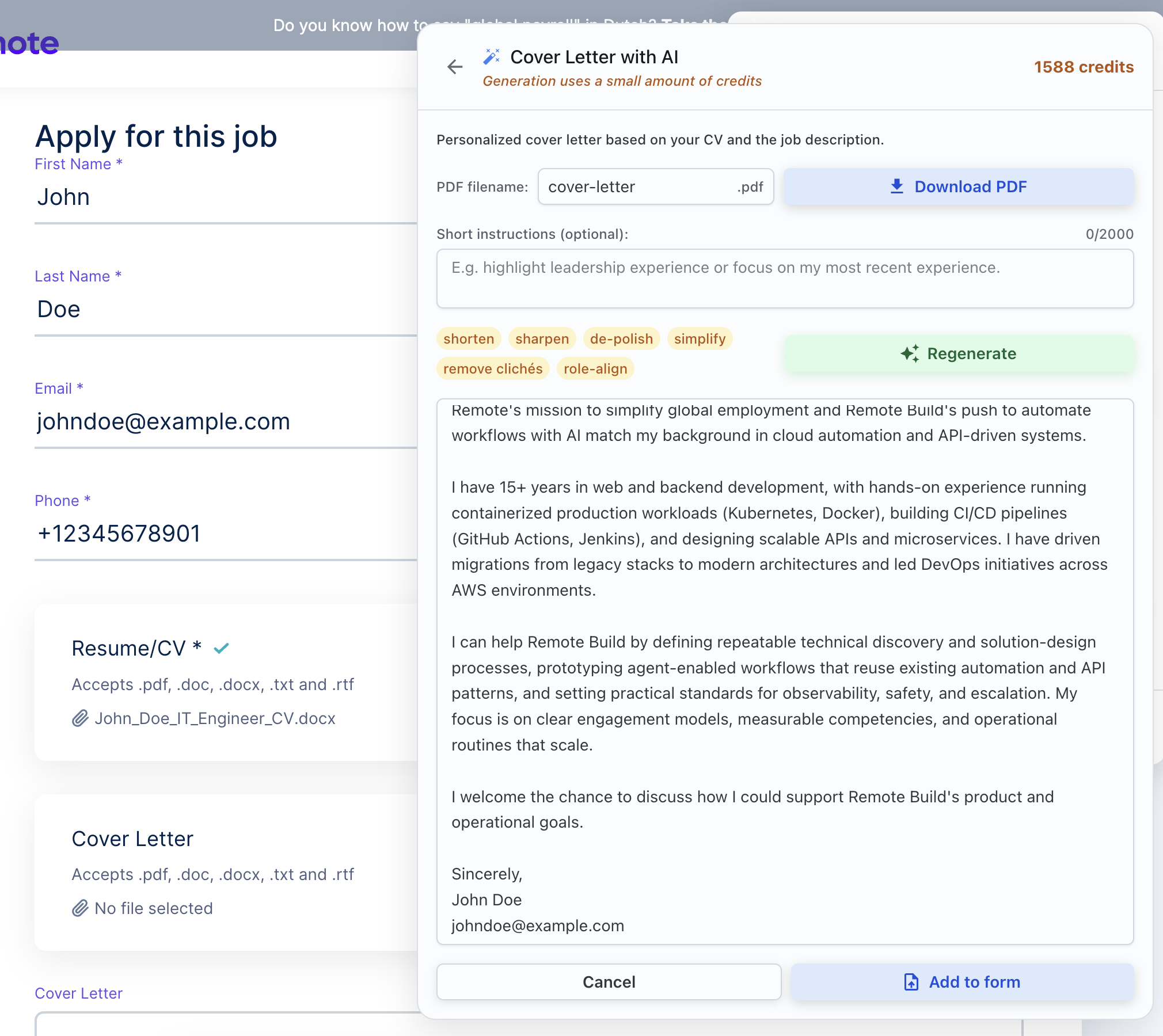
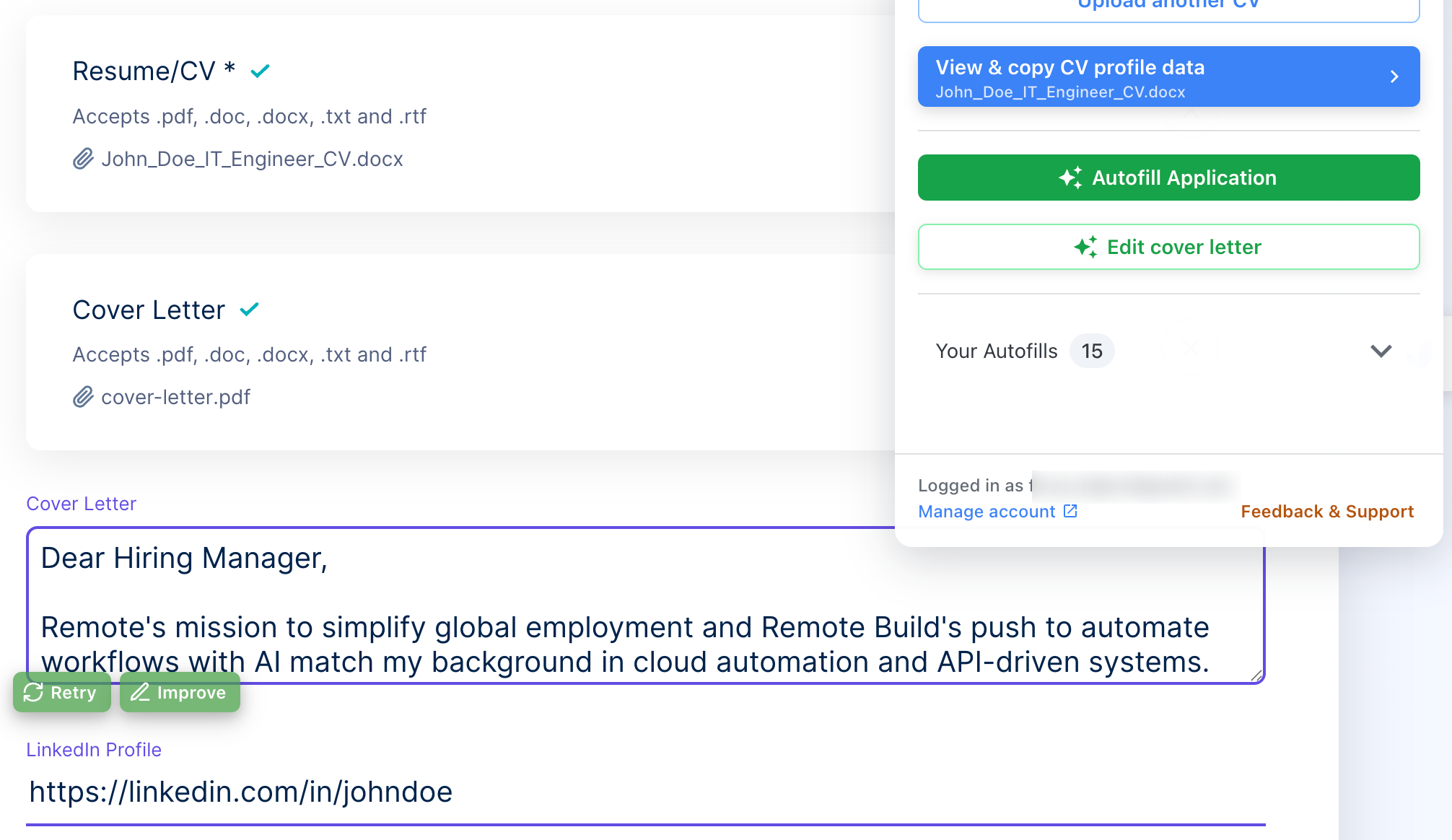
One thing we've seen building ApplyBtn's own generator: it drafts only from what's actually in your CV and the job posting, so it won't hand you a credential you don't have. But even a clean, honest draft still reads a little like AI until you rewrite it. That edit pass - putting the words in your own voice - is the step that removes the machine feel, not the generation itself.
AI cover letter generator tips: make it read like you
Now the practical side - the tips for using an AI cover letter generator that you actually need. Using a generator is not the risk. Sending its raw output is. Here's what separates a letter that gets read from one that blurs into the pile:
- Start from your real information, not a blank prompt. The biggest difference in quality is what the tool reads. A letter written from your real CV and this job's description already has specifics in it. A letter written from "write me a cover letter for a marketing role" is a template from the start. That's the whole idea behind an AI cover letter generator that reads your CV and the job description together - the specifics are the starting point, not extra work for you later. (Prompting ChatGPT yourself instead? Same idea, done by hand - use cover letter prompts for ChatGPT that paste in your CV and the job posting, not a blank request.)
- Rewrite the first line. Whatever the tool wrote, the opening line is where a template shows most. Replace it with one sentence, in your own voice, that names something concrete about the role.
- One real, checkable detail per paragraph. A project, a number, a named tool or market - something a generic letter could not contain, and something an interviewer could ask you about.
- Delete anything you can't stand behind. If a sentence claims something your resume doesn't support, and you couldn't explain it in person, cut it. This is also just honesty - you're the one signing the letter.
- Read it out loud once. A robotic rhythm is easier to hear than to see. Anywhere you stumble, or wouldn't really say it that way, rewrite it in the words you would actually use.
- Cut the over-the-top praise. AI drafts tend to be formal and too eager - piling praise on the company, using exclamation marks, telling everyone how thrilled and passionate you are. Recruiters read that as fake before they even think "AI." The letter's real job is to sound like a person: who you are, and why your background fits this role. The resume already lists your qualifications - don't just repeat them louder.
Ten minutes of this on top of a generated draft beats both extremes: the hour-long letter written from scratch, and the thirty-second raw paste. There's even research pointing the same way. On one hiring platform that added an AI cover-letter tool, employers soon trusted those letters less: the link between how well a letter matched the posting and how often it got a callback fell by about half (a 2025 preprint, not yet peer-reviewed). But applicants who spent time editing the draft still did better than those who sent it as-is. (If you're choosing a tool, we compared how personalized each one's output really is - built from your CV and the posting, or from a form you type into - in our best AI cover letter generators roundup. The same editing rules apply to generated application answers, which get the same 20-second read.)
The one-line answer
Can you check if a cover letter is AI generated? You can spot templates - and that's really all anyone can spot for sure, whether a human or a machine wrote it. Employers are mostly not hunting for AI. They're just skimming past generic letters. Write from your real CV and the real job description, edit until it sounds like you, and claim nothing you can't defend. Do that, and the detection question stops being your problem.