 By Lucy Vale
Your reason for applying - how to answer "Why do you want to work here?" honestly
The honest reason for applying is usually money - and the people asking usually know it. Here's what "Why are you applying?" is really testing, and how to answer it truthfully without sounding like a flight risk or reciting the mission statement.
Almost every job application asks some version of "Why are you applying for this position?" — either as an interview question or as a text box on the form. And here's the honest take, though it's an opinion: for most people the real reason is the same. They need a job, and this one pays. And the person asking usually knows this too.
So the question isn't really testing your passion. It's a simple check: did you spend five minutes learning about the job, and can you give a reason that isn't only "I need the money"? Once you see it this way, it stops being a trap. Here is how to answer it honestly — without lying, over-praising, or repeating the company's mission statement back at them.
What the question is actually testing
Not passion. Plenty of hiring managers say they don't even like the question. Some say that a candidate who repeats the company's "About Us" values tells them nothing, because almost every candidate repeats the same line. One long-time interviewer has called it a sign of a lazy interviewer; another said he simply stopped asking it, because all it shows is whether you spent five minutes on the website. These are opinions from people who run interviews, but they point the same way.
Two things follow from this:
- Too much enthusiasm backfires. If you say this is your absolute dream company and turn the excitement up to full, you can come across as fake rather than committed. Aim for honest interest, not a performance.
- Repeating the mission statement now works against you. "I love your commitment to innovation and excellence" is one of the most common answers there is, so it sounds like flattery the interviewer can see through. Saying something with nothing specific in it is barely better than saying nothing at all.
The bar you're really clearing is closer to "did this person do any homework, and can they explain why they fit" than "is this person in love with us."
Curated honesty: order your reasons, don't invent them
The move that works — the one experienced applicants keep coming back to — isn't lying, and it isn't blurting out "I need money." It's curated honesty: pick a reason that is genuinely true but isn't your main one, and lead with that.
You almost always have real reasons that aren't the paycheck: the hours fit your life, the place is close to home, the work is something you'd be happy doing for years, the industry is where you want to go, or you actually use and like the product. Any of these is honest. Putting them ahead of "the money" isn't dishonest — you're just not leading with the one reason that's true for every applicant everywhere.
Two rules keep it safe:
- Never lead with pay, benefits, or perks. This is the one point almost everyone agrees on, even people who hate the question. If you name money or perks as your reason, you signal that you'll leave the moment another company offers a dollar more. The benefits can be part of your plan; they're just not the sentence you open with.
- Always tie your honesty to what they get. The blunt-but-honest answers that people say actually worked always connect the money truth to the employer's benefit in the same breath. In one story that gets shared a lot, someone told a small-company owner: "I want financial stability and a comfortable life; work isn't my whole identity, but I'm good at this and I work hard" — and got hired. On the other side, people describe plain honesty with no "here's what you get" half leading to awkward silences, and in one case to being shut out of a whole hospital network. These are individual stories, not rules — but the pattern is consistent.
One important point: read who is across the table. That very blunt answer tends to charm the owner of a small business, but it can get you screened out by a big company's HR. Entry-level and hourly jobs accept plainly self-interested reasons that are true ("it's close to home," or "I've always had pets, so I'd rather work here than the same store down the road"). Senior roles don't. Match how polished you sound to how senior the role is.
The part that actually sinks people: "why here?"
Here's the mistake almost every bad-interview story shares. People prepare a decent, generic answer — stability, growth, a chance to help — and deliver it fine. Then comes the follow-up: "But why here? Why us, and not the other company hiring for this exact role?" — and they freeze. The generic answer survives the first question and dies on the second.
So the most useful thing you can prepare is one specific, checkable detail about this employer, plus one sentence on why it matters to you. Not the whole About page — just one hook: an award they won, a product you use, a line from the job posting, or something from recent news. A simple trick many applicants like: search the company name plus the word "award". Award write-ups are ready-made, specific praise you can point to ("I saw you were recognized for X — that's the kind of work I want to be part of").
That one detail is what turns "a reason to work somewhere like this" into "a reason to work here" — which is the real question behind the question.
The strongest version: what they get, not what you get
If you want to truly stand out, not just pass, flip it around. One interviewer with decades of experience described it like this: almost every answer he ever heard was about what the candidate would get — growth, training, culture, a foot in the door. The rare answer built around "here's the problem you're facing, and here's how I'd help with it" made the rest of the interview go better too.
You don't need to be an expert to use this. Take your real reason and turn it into their benefit: "I'm looking to build a solid track record in this field" becomes "I'd be reliable and stick around while I grow into the role." "I want industry experience" becomes "I already understand your space as a user, so I'd get up to speed fast." The question sounds like it's about you; the best answers make it about them.
Answering it in a written application form
Plenty of applications ask this as a text box — "Why do you want to work here?" — not out loud. The written version has its own rules, and opinions are genuinely split: some hiring people say they never read the box, while others say that box is exactly why a candidate got the interview. Since there's no agreement, the safe play is the same one most people land on: short, specific, and never blank.
- Never leave it empty — even when it says "optional." One applicant said they were rejected, and the reason given was the optional questions they had skipped. A blank box looks like low effort. Treat "optional" as a quiet test of whether you'll bother.
- Two or three sentences, plus one fact about the company. A reusable core ("I'd be a strong fit — I'm organized, reliable, and I do this work well") with one detail you looked up beats a long essay. At many big finance and tech companies especially, a long written answer can read as a bad sign — a thick file for a thin candidate.
- Don't paste raw ChatGPT. Some hiring people say an obviously AI-written box reads as lazy — "they couldn't even edit it" — and a few would rather see it blank. Reuse a template if you want (many people do), but the specific fact and the honest reason have to be yours.
Example answers that ring true
- Schedule-honest: "I'm looking for stability and a steady weekday schedule at this stage, and I saw you emphasize [value from their site] — that combination is why I applied here specifically."
- Student / entry-level: "I'm studying [field], so this role gives me real exposure to the industry while I finish school. It's a genuine step toward where I'm headed, which is also why I'd stay and grow into it."
- Give-not-get: "From the posting, it looks like you're scaling [team/process] fast, and [specific challenge] comes with that — that's exactly the kind of thing I'm good at, so the fit works both ways."
- Frontline / hourly: "Honestly, I like live events — people show up here excited, and that's the kind of place I'm at my best in." Plain and human beats corporate polish for these roles.
Notice what none of them do: none lead with money, over-praise, or repeat the mission statement. Each one pairs a true reason with either a specific hook or a benefit for the employer.
Writing it faster
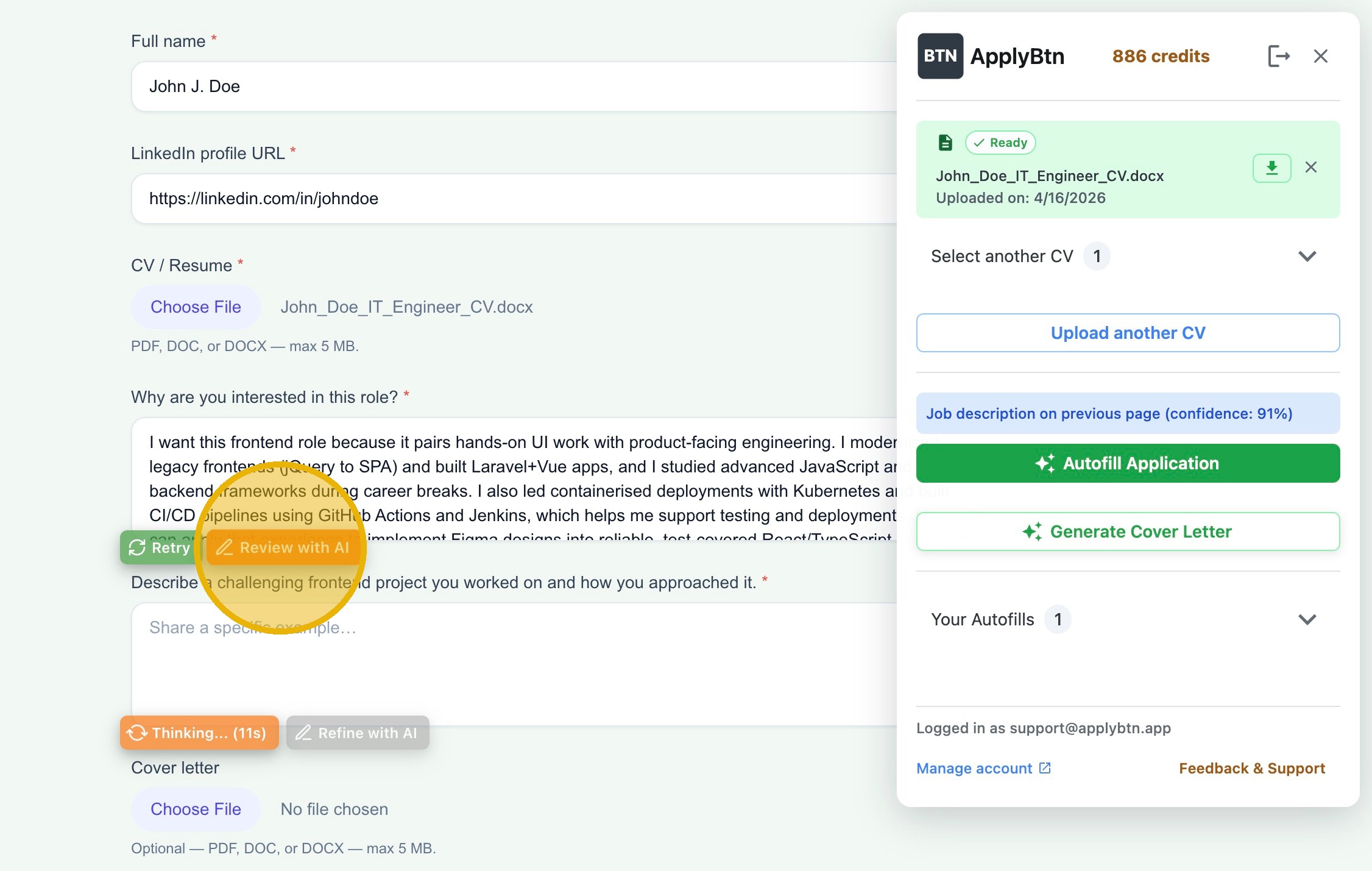
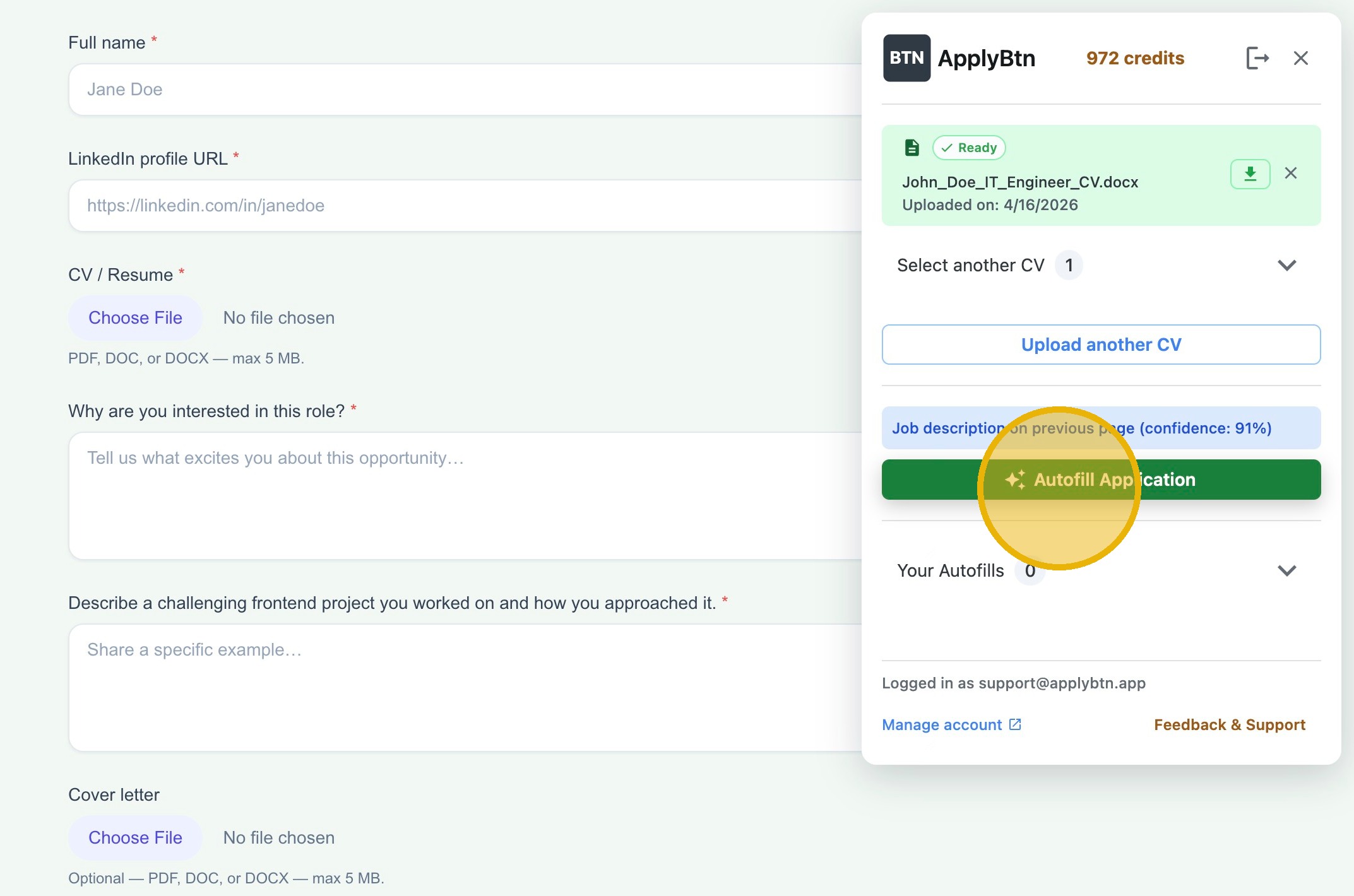
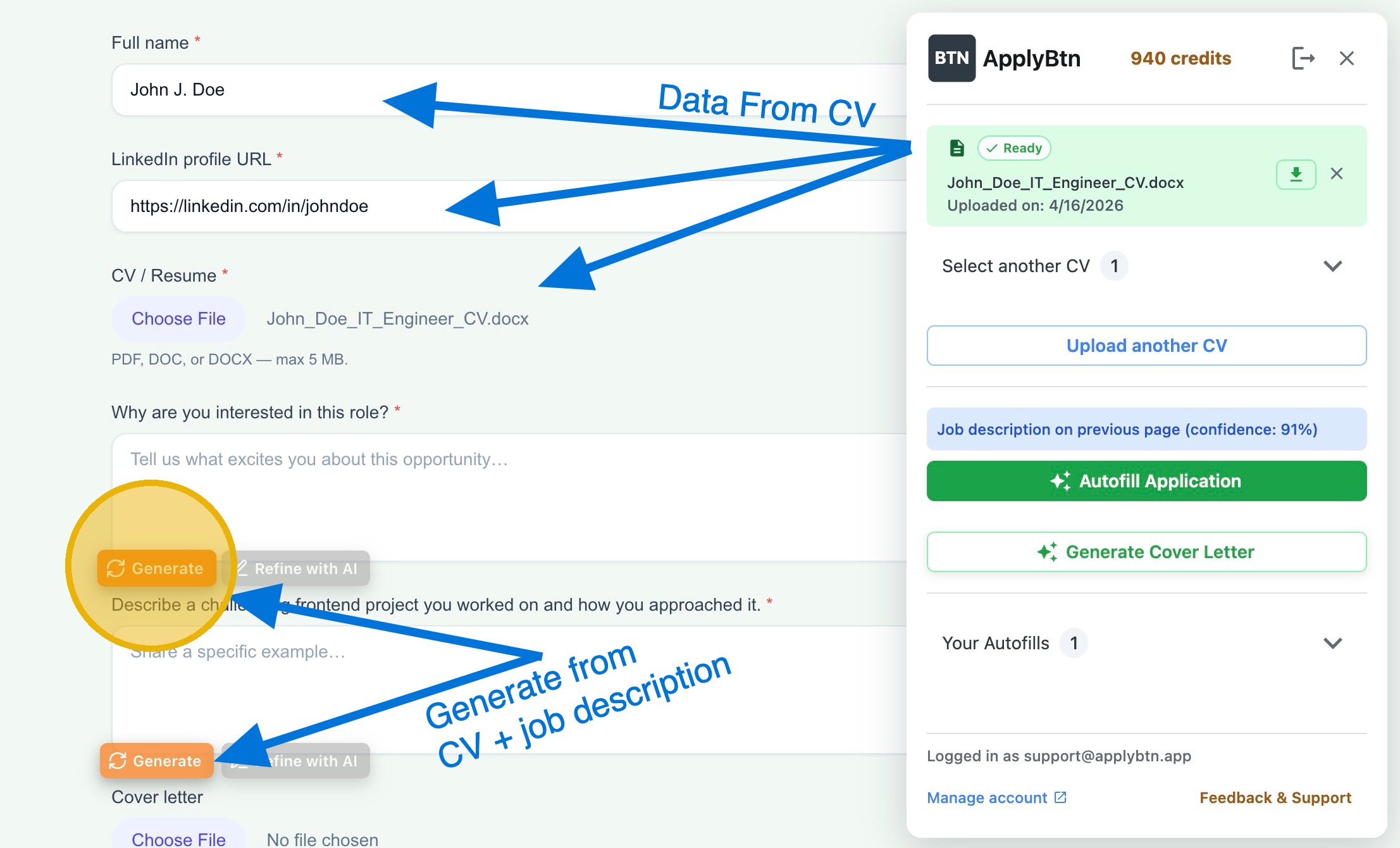
If this question feels exhausting, it's because you answer a version of it on every application, and each one needs a slightly different company hook. That repetition is exactly what a job application answer generator is built for — it reads your CV and the specific job posting together and drafts an answer based on both, right inside the form field, so you're editing instead of staring at a blank box.
When we built ApplyBtn's own answer generator, we made it open on one concrete detail from your CV and the posting, not generic enthusiasm — the same "specific, not generic" rule this whole guide is about. It won't add anything that isn't in your CV. What it still can't supply is the part that makes the answer land: your real reason, and the one detail about this employer. Add those, keep it honest, and "why are you applying?" stops being the question you dread. The same goes for the longer cover-letter-style boxes some forms use — a fast first draft that you make specific and true before it's sent.